How to Make a Rainbow of Rubber Stars
This is the second part of Ned Gorski's ground-breaking method which shows you how to make finished stars in 3 hours or less.
There are two critical components that make this new "rubber stars" method work.
First the star compositions all rely on Parlon (a synthetic rubber) dissolved in acetone for the binder. (Hence the nickname "rubber stars.") This parlon/acetone combination allows for extremely fast star drying.
The second component is a method of making stars called screen-slicing. Screen slicing is an extremely fast method for creating the individual stars.
The first part of the process, described in How to Make Screen-Sliced Brilliant-Red Rubber Stars, describes the physical techniques used in making the stars. In that article, Ned provided one star formula, for red stars, to use to demonstrate the screen-slicing method.
In this second part of the series, Ned gives you an extraordinary color system which enables you to make virtually any color of star with a single set of chemicals. The types of chemical formulas used in Part 1 and Part 2 are different--they are not interchangeable.
But the chemical system shown here will allow you virtually infinite flexibility. Formulas for all the basic colors are given to you. And you can just use those recipes and make great colored stars.
But Ned goes further. He shows you how to mix colors and derive a virtually infinite set of color options for rubber stars.
If you have not already read it, you should start by reading the first part in the series, so that you familiarize yourself with the rubber star making techniques.
Our publication of these two articles is an important one. I personally only know of one other viable complete color system for making stars, Robert Veline’s System. While both color systems are important innovations in making a virtually infinite array of colors available to pyrotechnicians, Gorski’s Rubber Star Method is stands above all other star making methods in its ability to make stars faster than all the others.
Enjoy the infinite array of colors you can make with this project and kit.
Harry Gilliam
Make Fireworks Stars the Easy Way
The "rainbow" of star colors I'll be discussing here builds on the methods detailed in the How to Make Screen-Sliced Brilliant-Red Rubber Stars project to expand your color palette of star choices.
Note: Be sure you learn and are familiar with that new way of making and priming stars before starting on this project!
The screen-sliced rubber stars production method has significant advantages for the small-scale hobbyist:

A Pair of Amateur-Built "Stained Glass" (or "Kaleidoscope") Shells
Photo by Tom Handel
So how do you make a rainbow of color stars to go with those charcoal stars and glitter stars, silver-spark tailed stars, or a nice white star? At the same time, can we get around the problems of using chemicals that are hard to obtain or require special drying?
The purpose of this project is to answer these questions with a set of well-balanced color star formulas that use easily available and relatively non-hygroscopic chemicals. These formulas are designed to work well with the screen-slicing method described in How to Make Screen-Sliced Brilliant-Red Rubber Stars.
Now if I were you, I'd be clamoring to get my paws on those formulas and itching to start getting my hands dirty right away. So, I'm going to give you the table of new formulas right up front. Your job for this project is to use these new formulas along with the screen-slicing process you learned in the red rubber stars project to make some of these beautifully colored stars and try them out.
However, when you've worn out your hands (or exhausted your pyro budget), come on back in here and read the two sections of this project that come after the star formula table below.
In the first one, "Pyrotechnic Color," I'll explain how these (and other) formulas work to create colored flames and how you can mix and modify them to create even more colors for your pyro palette.
Finally, in "Developing a System of Bright Stars using Carbonates," I will show you how to approach a major pyro research project by explaining how I went about developing this one. In doing so, I'll include many more useful color star formulas for you to try and experiment with.
The numbers in the tables throughout this project are "factors," as described in How to Make Screen-Sliced Brilliant-Red Rubber Stars. Multiply these factors by your desired batch weight to get the quantity/weight of each chemical required for the batch.
Here is how to use the factors in the table below to calculate the weight of the chemicals needed for an 8-ounce batch of red stars. The required amounts of the various components would be:
Factor x batch weight total = amount of chemical needed
So, without further ado, here are the final formulas for a rainbow of screen-sliced stars you can make using the tools and techniques explained in the first project.
Note: A few words about "magnalium," one of my favorite subjects. Magnalium is also sometimes referred to as "MgAl," "Mg/Al," "MagAl," "magnesium-aluminum," and probably a few other names I've forgotten. Having all these names for the same material makes this substance the cause of more confusion, misunderstanding and puzzlement by new pyros than virtually any other frequently-used pyro chemical. Magnalium is an alloy (chemical combination) of magnesium and aluminum which provides a good compromise between the reactivity of magnesium and the stability of aluminum. It is not a mixture of aluminum and magnesium powders, nor does a mix of those powders perform the same way, pyrotechnically, as magnalium. Magnalium is less prone to unwanted reactions with water and other chemicals used in pyro than pure magnesium, but more reactive than pure aluminum. Magnalium used in pyro is usually an equal (50:50 by weight) alloy of aluminum and magnesium, though other alloy proportions, generally containing less magnesium and more aluminum, are sometimes used. On the Skylighter site you'll find this material under "Magnesium-Aluminum."
Note: Changing the mesh of the magnalium changes the star's burn speed. Mesh sizes from 60-mesh to 325-mesh may be experimented with. I suggest you start with about 200-mesh and work from there.
Note: 5% (factor = 0.05) titanium or ferro-titanium may be added to any color composition for a silver-spark tail.
Note: For a bright white star with no spark-tail, eliminate the titanium/ferro-titanium from the Silver-White formula. Or, the titanium/ferro-titanium content may be doubled for an even denser spark-tail.
An 8-ounce batch of a star composition is a workable quantity when using a Skylighter's 12 inch x 12 inch, 3-mesh framed screen, and produces nice stars that are about 3/8-inch diameter. The composition should be rolled into a patty using 3/16-inch spacers, sliced through a 3-mesh screen per the screen-sliced stars method, and also primed with the two primes shown in that method.
These 3/8-inch stars are useful for shells in the 3-inch to 5-inch diameter range. One 8-ounce batch will be approximately enough for five 3-inch ball shells, two 4-inch shells, or one 5-inch shell.
A 24-ounce batch of star composition, rolled into a patty using 5/16-inch spacers, is a workable quantity when sliced through one of Skylighter's framed 2-mesh screens. After being primed, nice stars in the 9/16-inch diameter range will be produced. These stars are useful in shells in the 6-inch to 8-inch diameter range. One batch of stars will be approximately enough for a 6-inch ball shell.
Note: Depending on the metal content of the particular star composition being used, these shell requirements will vary, and will need to be dialed in for each particular situation.
Now go have some fun. Then come back later and read the rest of this. I promise you'll find it worthwhile.
Note: A superb pyrotechnic reference which covers most of the subject matter in this section plus much more is Pyrocolor Harmony, A Designer's Guide by Joel Baechle. Highly recommended.
Color-and the human perception of it-is a very interesting and very complicated subject, and we won't attempt to discuss it thoroughly here. However, a few words about it may make the process of creating color in pyrotechnics a little easier to understand.

The Visible Spectrum
Certain atoms and molecules, called "color-producers," emit light in various narrow parts of the visible spectrum above when exposed to high heat. These narrow parts of the spectrum correspond to particular colors.
For example, strontium atoms emit light in the red part of the spectrum when heated to a high temperature. Barium atoms, similarly, emit light in the green part of the spectrum. So the pyrotechnist's task in the simplest case is to create a high temperature environment and expose strontium to it, for example, so that red light will be created.
Fireworks burn in a pyrotechnic reaction. Unlike the charcoal in your grill, which burns by combining with oxygen in the air, fireworks do not depend on the air to burn. Instead, fireworks incorporate a chemical called an oxidizer which provides the oxygen for them to burn in the pyrotechnic reaction.
Study the formula for red stars in the table above. The potassium perchlorate is the oxidizer, providing the oxygen, and the magnalium is the primary fuel. When they burn together, they create the high temperatures we need. The strontium in this formula is provided by the strontium carbonate. The fuel and oxidizer burn, the strontium is heated, et voila - red light.
OK, both of these act in part as fuels, so they will provide additional heat by burning with the oxygen from the potassium perchlorate. The red gum also acts as a binder to help hold the stars together and improves the workability and drying characteristics of the mix.
Parlon, a synthetic "rubber," also serves as an important binder. But it has an even more important role to play in helping to produce the color.
Strontium atoms by themselves emit red light when heated to high temperature. But, a molecule combining strontium and chlorine, called strontium monochloride (SrCl), emits an even stronger red light that also has other very desirable characteristics. SrCl is unstable at room temperature, and so we can't just "mix some in" to the formula. It must instead be created "on the fly" in the flame while the star is burning.
So, we have the strontium already in the flame-we need some chlorine. Enter the Parlon.
Parlon is referred to in pyrotechnics as a "chlorine donor." It is made up mostly of carbon, hydrogen and quite a lot of chlorine. When it is heated in the presence of oxygen, the carbon and hydrogen combine with oxygen from the oxidizer and burn off, and the chlorine is liberated ("donated") into the flame.
When strontium is also present, some of the chlorine will combine with some of the strontium in the flame, and the resulting strontium monochloride will emit a deeper, richer red light than strontium without the chlorine. That's just what we want, and that is exactly how this excellent red star formula "works."
Ok, bear with me now. Look at the green star formula in the table above. Note that it is identical to the red star formula except that the strontium carbonate has been replaced by barium carbonate.
This formula works for green light in exactly the same way as the red formula works for red light. The potassium perchlorate and magnalium burn to provide the heat. The barium carbonate provides the barium, which emits green light in the heat of the flame. The Parlon provides the chlorine which combines with the barium in the flame to form barium monochloride (BaCl), which produces an even stronger and more attractive green light.
Same goes for the red-orange formula. Calcium plays the same "color-producer" role that strontium plays in the red formula and barium plays in the green formula. Calcium produces a red-orange color.
The blue formula works nearly the same way, with the copper in the copper carbonate playing the role of color-producer. However, the source of blue light, copper monochloride, requires a cooler flame to exist than in the earlier examples. The magnalium (which makes a very hot flame) has therefore been eliminated. Lactose, a fuel which creates a cooler flame, has been substituted for it.
As an alternative, now look at the yellow formula in the table above. It appears pretty much like the others, except that it has both strontium (red) and barium (green) color-producers in it. Red and green? What's this all about? For the answer, go find a strong magnifying glass and turn on your TV or your computer monitor.
When you very closely inspect the screen of a color TV/monitor, you can see that it is made up of millions of tiny dots, each of which is emitting pure red, pure green or pure blue light. If you search the whole screen, you won't find a single tiny lighted dot that is yellow or purple or orange or any other color - just red, green and blue.
Now back off from the screen and find an area of the screen that appears to be yellow. Take the magnifying glass to it and notice that in the yellow area, the red and green dots are brightly lit, and the blue is very dim or entirely off.
Back off again and look at that area of the screen. It sure looks yellow doesn't it? But now you know that the only light coming off that area of the screen is, in reality, pure red and pure green. The two colors mix in our perception and we see yellow.
Similarly, in the yellow star above, the red from the strontium and the green from the barium mix in our perception and we see the star as yellow.
Note: Colored light produced from luminous sources, such as your TV/monitor screen or a burning star, mixes to create new colors by a process called "additive mixing." The image below illustrates the way red, green and blue light mix. This is different from the way colors from sources of reflected light (like paints) mix, which is called "subtractive mixing." For example, if you mix red and green light (as we have seen above and as is illustrated below) you get yellow. If you mix red and green paint, you get ... well, not yellow.
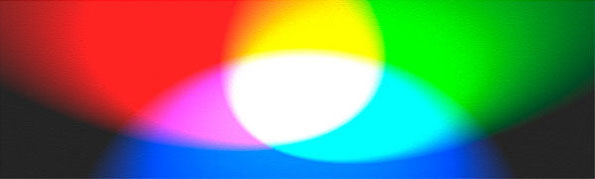
Additive Mixing
Do the same experiment with the TV/monitor and an area of the screen that from a distance appears purple (violet) or magenta. You'll find when you look closely that the red and blue dots are lit brightly and the green dots are very dim or off. Purple light can be produced by a mixture of red light and blue light.
In the star formulas above, you can see that the indigo and violet stars are variations on the blue star. They contain mixtures of copper (blue light) and strontium (red light) which mix in our perception and we see the purple colors.
All of the many colors you see on your TV/monitor screen are made up of pure red, pure green and pure blue light mixed in various proportions and levels of brightness. Similarly, at least in theory, you can create a complete rainbow of star colors by varying the proportions of red, green and blue color-producers in the formula. White light is created when all three colors (red green and blue) are present in proper proportion, but there are easier ways to create white light in pyrotechnic stars than mixing red, green and blue formulas.
This little bit of explanation, coupled with the formulas presented in the above table, provides the basis for creating even more color variations. For example, starting with the yellow formula from the table, increase the red (strontium carbonate) a little and decrease the green (barium carbonate) to move the color toward orange. Chartreuse is created when the ratio is shifted the other way by reducing the strontium carbonate and adding more barium carbonate. (Now you know what chartreuse is.) Here are some experimental formulas for orange and chartreuse (as well as the original yellow formula) that will give you a place to start.
Here is a "color wheel" to illustrate some approaches to combining colors.
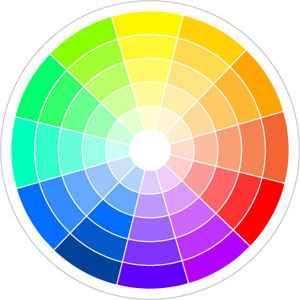
Color Wheel
Traditionally, colors that are opposite each other on the color wheel are viewed as "complementary" in that they bring out the best in each other, for example:
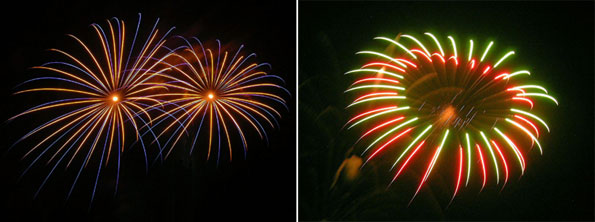
Blue and Gold / Red and Green
Photos by Tom Handel
Another consideration is that often a "so-so" color will really pop and look great when contrasted with other colors. A good blue outer petal, contrasted with a good red inner petal, will make both colors look great.

Shell by Ned Gorski
Photo by Tom Calderwood
It's hard to imagine one of the darker colors, red or green or purple or (especially) blue, not looking great mixed with gold-glitter stars.
Silver-streamer stars mixed with brilliant red stars look amazing.
And a "variegated" color shell-all the colors of the rainbow mixed in with each other-can be outstanding, especially if all the stars compare favorably in brightness and burn-duration.
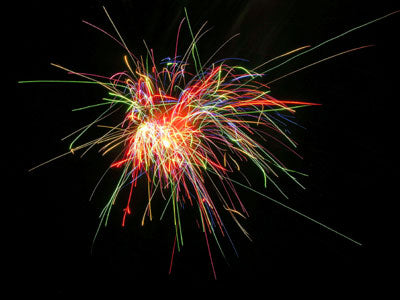
Variegated Shell
Photo by Tom Handel
"Well heck" [family-friendly version], you might say, "why do I care about that? Y'all already gave me the formulas."
Ok, that's right. But you, like most practicing pyros as they become more advanced in their craft, will at one time or another want to take on a "research project" such as this. It is not always intuitive or easy to organize and pursue such a project, or to know where to start. While there are many ways to go about it, one of my objectives here is to provide one example from my experience that might be useful to you as a model for how to approach your own research projects.
Another objective is to give you a whole bunch more colored star formulas (and their sources) that are compatible with the screen-slicing method. Depending on your needs and what chemicals you have access to, some of these may work as well or better for you than the formulas I have developed.
The goal for this project is to discover or develop a relatively simple set of formulas
The best place to begin is often where you left off, so here is the red formula from the earlier "How to Make Screen-Sliced Brilliant-Red Rubber Stars" project. This formula is based on a well known formula called "Independence Red," which I modified. The original formula used dextrin and water as the binder. Because I used the Parlon with acetone to bind these stars in the screen-slicing method, I eliminated the dextrin from my formula.
In this formula, the oxidizer (strontium nitrate) is also the color-producer. In addition to providing the oxygen to burn with the fuel (magnalium) in the pyrotechnic reaction, it also provides strontium to create red light.
I'm also including here some formulas I developed based on the red formula by simply substituting different oxidizers (and therefore different color-producers). Barium nitrate provides oxygen and provides barium to the flame to create green light, and potassium nitrate provides oxygen and provides potassium to the flame to create a pale peachy-lavender color.
As explained in the "Pyrotechnic Color" section above, including both the strontium and the barium (red and green light respectively) in the same formula creates the yellow star.
A similar set of potentially useful formulas is provided by Troy Fish's original green and red compositions from his article, "Green and Other Colored Flame Metal Fuel Compositions using Parlon" in Pyrotechnica VII. These were as follows:
All these star formulas-both my brilliant rubber stars formulas and the Troy Fish formulas-produce excellent colors. They are bound with Parlon-acetone and so are compatible with the screen-slicing method.
They also share a few drawbacks, though.
Note: Veline's actual formulas include dextrin as the binder. Since I want to use Parlon as the binder, Veline's original factors have been adjusted in this table after eliminating the water-activated dextrin binder.
This is a well-known set of star formulas which covers the full color spectrum. The formulas include Parlon and red gum, and hence are compatible with the screen-slicing method.
The formulas are chemically compatible and use interchangeable components. As one of Veline's goals in designing this system was to achieve a full spectrum of chemically compatible color stars with approximately the same (balanced) intensity and similar burn-times, this looks promising.
However, there are also some drawbacks.
In summary, some of the Veline formulas produce nice colors, but the Veline green and yellow still depend on barium nitrate, and the Veline blue is pale since it employs magnalium as a fuel.
The search continued...
Once again, these factors have been rounded off after eliminating the original water-activated dextrin binder and, in this case, boric acid as well.
The presence of Parlon and red gum in these formulas makes them suitable for the screen-slicing method. These stars use a system of compatible chemicals, and the green formula is the first to satisfy my requirement to avoid barium nitrate as a color-producer.
On the down side, the system-even extended as above with my yellow and white formulas-does not cover the full color spectrum. There is no blue or purple formula in this particular system.
Experimenting with this system, I created the yellow and white formulas in the table above based on the original HWW formulas.
HWW did make an unclear reference to achieving a bright yellow star by replacing all or part of the strontium carbonate in the red formula with ultramarine blue, a complex mineral pigment containing sodium. Instead, however, I devised the experimental yellow formula given above based on the approximate proportion of red and green compositions that is often mixed to produce yellow. It created a very pleasing light, non-orangey, yellow star.
The white formula used the same formula as the color stars, but increased the percentages of the oxidizer (potassium perchlorate) and fuel (magnalium) to make up for the eliminated carbonate color-producer. The Parlon and the red gum were kept the same. A very nice, bright white star resulted.
A little further work indicated that if 5-10% titanium or ferro-titanium is added to these formulas, a very pleasing silver or yellowish-silver-spark tail can be added to the star. This is particularly effective with the yellow and white stars.
But what I found most intriguing about this set of formulas was the inclusion-finally-of a green star which does not use barium nitrate! Instead, it specifies only barium carbonate which is readily available to just about everyone.
So, naturally, I was anxious to try the barium carbonate green formula, and happy to find that a very pleasing, deep and usable green color was achieved using only the carbonate. Cool. With this formula, no barium nitrate is necessary.
The red and red-orange stars were also very bright, nice color stars. And no strontium nitrate was necessary in those compositions, meeting another one of my goals.
In summary, this set of formulas, employs four chemicals common to all formulas plus carbonate(s) as color-producers. It is suitable for screen slicing, and produces a nice range of colors in the red to green part of the spectrum. These stars go a long way toward achieving the desired rainbow of colors and meeting the other goals of this research project.
However, I needed to continue the search for compatible formulas which would deliver stars with similar brightness and burn rate characteristics in the blue to violet part of the spectrum
Once again, a bit of rounding off of factors has been done in the conversion of the above formulas from "parts" (in the original) to factors in this table. Five-percent titanium or ferro-titanium may be added to any of the color compositions for a silver-spark tail.
Gary's formulas cover the full spectrum of color, and the presence of Parlon and red gum in all formulas makes them suitable for the screen-slicing method which Gary developed.
However, Gary uses strontium nitrate and barium nitrate in many of his formulas for stars in the red to green part of the spectrum. I was seeking to avoid using these oxidizers for the reasons discussed earlier, and so Gary's system could not be adopted in its entirety.
However, Gary's blue and purple compositions looked interesting. So I focused on them. With a few modifications, these formulas might serve to fill out the rest of my rainbow.
Time for some more experimentation.
Gary's blue and violet use hexamine as a cooler-burning fuel to replace the hot-burning magnalium used in his other formulas. I'm not fond of using hexamine. It stinks (literally) and is very hygroscopic. I once suspected it of attracting moisture in some lance formulas I was working with, so I left a little pile of the hexamine out on a sheet of paper in a humid shop. The next morning all that was left of it was a liquid puddle.
So, instead of the hexamine I decided to use lactose, which Ofca specifies as the "cool fuel" in his chlorate blue formula in Bill Ofca's Technique in Fire, Volume 5, Mastering Cut Stars the Easy Way.
I simply substituted lactose for hexamine, one for one, when using Gary's blue formula, and I really liked the resulting blue star.
Substituting strontium carbonate for 1/2 of the copper carbonate in the blue formula produced a nice deep, bluish-indigo purple. Substituting strontium carbonate for 3/4 of the copper carbonate resulted in a more reddish purple, one that looked violet or fuchsia to me.
Note: As a bonus, Gary's silver-streamer star, which uses exceptionally coarse magnalium and titanium-sponge, produces a great, sizzling silver-star effect, with long-delay silver sparks in the tail. While such a star was not an objective of this research project, it is a noteworthy effect and would make a nice complement to any of the color stars developed here.
In summary, very pleasing blue, indigo, and violet stars can be made, starting with Gary's blue formula and modifying it for the purplish stars. A "cooler" aqua experimental star might be an idea for further development-without any magnalium, and replacing some of the copper carbonate in the blue formula with barium carbonate. So many experiments-so little time.
If one has strontium nitrate and/or barium nitrate on hand and doesn't mind using them, the original formulas we started with offer outstanding brilliant red, green and yellow colors. And if potassium nitrate is used in those formulas, a pleasing peachy-lavender color can be achieved.
But, my goal was to arrive at a relatively simple set of formulas
The red, red-orange, yellow and green are, or are based on, the "HWW" formulas. The blue is my lactose-fueled version of Gary Smith's hexamine fueled star, and the indigo and violet are my variations on that blue.
I've also included a white/silver-streamer star derived from the "HWW" formulas by leaving out the carbonates and adjusting the oxidizer and fuel quantities accordingly. This star would make a nice complement to any of the rainbow stars if used together with them.
And, now you have all the makings for stars that fit that the objective of a "rainbow of colors." Here are a few other shells that might inspire you.
6-Inch Ball-Shells with Screen-Sliced Parlon Stars
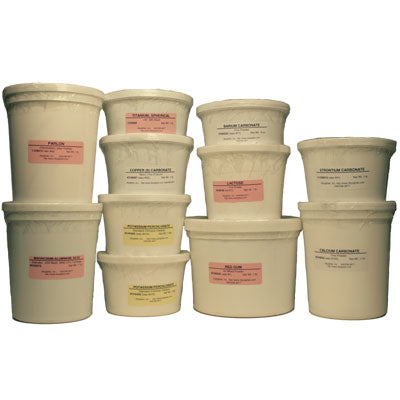
All the chemicals you'll need to make fireworks stars the easiest way possible
in 8 different colors.
There are two critical components that make this new "rubber stars" method work.
First the star compositions all rely on Parlon (a synthetic rubber) dissolved in acetone for the binder. (Hence the nickname "rubber stars.") This parlon/acetone combination allows for extremely fast star drying.
The second component is a method of making stars called screen-slicing. Screen slicing is an extremely fast method for creating the individual stars.
The first part of the process, described in How to Make Screen-Sliced Brilliant-Red Rubber Stars, describes the physical techniques used in making the stars. In that article, Ned provided one star formula, for red stars, to use to demonstrate the screen-slicing method.
In this second part of the series, Ned gives you an extraordinary color system which enables you to make virtually any color of star with a single set of chemicals. The types of chemical formulas used in Part 1 and Part 2 are different--they are not interchangeable.
But the chemical system shown here will allow you virtually infinite flexibility. Formulas for all the basic colors are given to you. And you can just use those recipes and make great colored stars.
But Ned goes further. He shows you how to mix colors and derive a virtually infinite set of color options for rubber stars.
If you have not already read it, you should start by reading the first part in the series, so that you familiarize yourself with the rubber star making techniques.
Our publication of these two articles is an important one. I personally only know of one other viable complete color system for making stars, Robert Veline’s System. While both color systems are important innovations in making a virtually infinite array of colors available to pyrotechnicians, Gorski’s Rubber Star Method is stands above all other star making methods in its ability to make stars faster than all the others.
Enjoy the infinite array of colors you can make with this project and kit.
Harry Gilliam
Make Fireworks Stars the Easy Way
in 3 Hours!
By Ned Gorski
The "rainbow" of star colors I'll be discussing here builds on the methods detailed in the How to Make Screen-Sliced Brilliant-Red Rubber Stars project to expand your color palette of star choices.
Note: Be sure you learn and are familiar with that new way of making and priming stars before starting on this project!
The screen-sliced rubber stars production method has significant advantages for the small-scale hobbyist:
- A full range of great colors with a small collection of chemicals
- Simple and fast star-making process
- Fast drying stars, which are great for on-site pyro-device manufacture
- Very specific quantities of stars can be made, minimizing storage of excess stars
- Matching-color rising tails for shells and rockets can be made at the same time as the stars
- Metal particles may be added to the stars to create spark-trails behind the color-star heads
A Pair of Amateur-Built "Stained Glass" (or "Kaleidoscope") Shells
Photo by Tom Handel
So how do you make a rainbow of color stars to go with those charcoal stars and glitter stars, silver-spark tailed stars, or a nice white star? At the same time, can we get around the problems of using chemicals that are hard to obtain or require special drying?
The purpose of this project is to answer these questions with a set of well-balanced color star formulas that use easily available and relatively non-hygroscopic chemicals. These formulas are designed to work well with the screen-slicing method described in How to Make Screen-Sliced Brilliant-Red Rubber Stars.
Now if I were you, I'd be clamoring to get my paws on those formulas and itching to start getting my hands dirty right away. So, I'm going to give you the table of new formulas right up front. Your job for this project is to use these new formulas along with the screen-slicing process you learned in the red rubber stars project to make some of these beautifully colored stars and try them out.
However, when you've worn out your hands (or exhausted your pyro budget), come on back in here and read the two sections of this project that come after the star formula table below.
In the first one, "Pyrotechnic Color," I'll explain how these (and other) formulas work to create colored flames and how you can mix and modify them to create even more colors for your pyro palette.
Finally, in "Developing a System of Bright Stars using Carbonates," I will show you how to approach a major pyro research project by explaining how I went about developing this one. In doing so, I'll include many more useful color star formulas for you to try and experiment with.
System of Bright Star Formulas using Magnalium and Carbonates
The only oxidizer you will need is potassium perchlorate. Unlike the strontium nitrate in the first project, neither the potassium perchlorate nor the other chemicals in these formulas should require special drying. All of them except for the metals should be fine, free-flowing powders.The numbers in the tables throughout this project are "factors," as described in How to Make Screen-Sliced Brilliant-Red Rubber Stars. Multiply these factors by your desired batch weight to get the quantity/weight of each chemical required for the batch.
Here is how to use the factors in the table below to calculate the weight of the chemicals needed for an 8-ounce batch of red stars. The required amounts of the various components would be:
- Potassium perchlorate 0.3 x 8 = 2.4 ounces
- Magnalium 0.3 x 8 = 2.4 ounces
- Strontium carbonate 0.2 x 8 = 1.6 ounces
- Parlon 0.15 x 8 = 1.2 ounces
- Red gum 0.05 x 8 = 0.4 ounce
So, without further ado, here are the final formulas for a rainbow of screen-sliced stars you can make using the tools and techniques explained in the first project.
Rainbow of Rubber Stars (high Magnalium & Carbonate system)
| Component | Red | Red- Orange |
Yellow | Green | Silver- White |
Blue | Indigo | Violet |
| Potassium perchlorate | 0.3 | 0.3 | 0.3 | 0.3 | 0.38 | 0.63 | 0.63 | 0.63 |
| Magnalium | 0.3 | 0.3 | 0.3 | 0.3 | 0.38 | |||
| Strontium carbonate | 0.2 | 0.05 | 0.06 | 0.09 | ||||
| Calcium carbonate | 0.2 | |||||||
| Barium carbonate | 0.15 | 0.2 | ||||||
| Copper carbonate | 0.12 | 0.06 | 0.03 | |||||
| Parlon | 0.15 | 0.15 | 0.15 | 0.15 | 0.14 | 0.15 | 0.15 | 0.15 |
| Red gum | 0.05 | 0.05 | 0.05 | 0.05 | 0.05 | 0.05 | 0.05 | 0.05 |
| Titanium or Ferro-Ti | 0.05 | |||||||
| Lactose | 0.05 | 0.05 | 0.05 |
Are you fixing to make a batch of Rubber stars, complete with prime and all the fixings, but don't want to calculate the ratios for your batch size?
Well, one of the Skylighter faithful did all the math for you and provided a MS Excel sheet that calculates all the details in an instant. Just select the color, and enter your batch size and it does all the work for you.
Free Download Here: Rainbow of Rubber Stars Calculator
Well, one of the Skylighter faithful did all the math for you and provided a MS Excel sheet that calculates all the details in an instant. Just select the color, and enter your batch size and it does all the work for you.
Note: A few words about "magnalium," one of my favorite subjects. Magnalium is also sometimes referred to as "MgAl," "Mg/Al," "MagAl," "magnesium-aluminum," and probably a few other names I've forgotten. Having all these names for the same material makes this substance the cause of more confusion, misunderstanding and puzzlement by new pyros than virtually any other frequently-used pyro chemical. Magnalium is an alloy (chemical combination) of magnesium and aluminum which provides a good compromise between the reactivity of magnesium and the stability of aluminum. It is not a mixture of aluminum and magnesium powders, nor does a mix of those powders perform the same way, pyrotechnically, as magnalium. Magnalium is less prone to unwanted reactions with water and other chemicals used in pyro than pure magnesium, but more reactive than pure aluminum. Magnalium used in pyro is usually an equal (50:50 by weight) alloy of aluminum and magnesium, though other alloy proportions, generally containing less magnesium and more aluminum, are sometimes used. On the Skylighter site you'll find this material under "Magnesium-Aluminum."
Note: Changing the mesh of the magnalium changes the star's burn speed. Mesh sizes from 60-mesh to 325-mesh may be experimented with. I suggest you start with about 200-mesh and work from there.
Note: 5% (factor = 0.05) titanium or ferro-titanium may be added to any color composition for a silver-spark tail.
Note: For a bright white star with no spark-tail, eliminate the titanium/ferro-titanium from the Silver-White formula. Or, the titanium/ferro-titanium content may be doubled for an even denser spark-tail.
An 8-ounce batch of a star composition is a workable quantity when using a Skylighter's 12 inch x 12 inch, 3-mesh framed screen, and produces nice stars that are about 3/8-inch diameter. The composition should be rolled into a patty using 3/16-inch spacers, sliced through a 3-mesh screen per the screen-sliced stars method, and also primed with the two primes shown in that method.
These 3/8-inch stars are useful for shells in the 3-inch to 5-inch diameter range. One 8-ounce batch will be approximately enough for five 3-inch ball shells, two 4-inch shells, or one 5-inch shell.
A 24-ounce batch of star composition, rolled into a patty using 5/16-inch spacers, is a workable quantity when sliced through one of Skylighter's framed 2-mesh screens. After being primed, nice stars in the 9/16-inch diameter range will be produced. These stars are useful in shells in the 6-inch to 8-inch diameter range. One batch of stars will be approximately enough for a 6-inch ball shell.
Note: Depending on the metal content of the particular star composition being used, these shell requirements will vary, and will need to be dialed in for each particular situation.
Now go have some fun. Then come back later and read the rest of this. I promise you'll find it worthwhile.
Pyrotechnic Color
Using the formulas from the table above, the purpose of this section is to show you the way chemicals are used to create color in pyrotechnic flames. I will also introduce some of the tools and techniques you can use to control that process and the colors that are produced. This will provide a foundation of knowledge which you can use to begin to modify the formulas above to create new colors, and eventually to create your own formulas for pyrotechnic colored flames.Note: A superb pyrotechnic reference which covers most of the subject matter in this section plus much more is Pyrocolor Harmony, A Designer's Guide by Joel Baechle. Highly recommended.
Color-and the human perception of it-is a very interesting and very complicated subject, and we won't attempt to discuss it thoroughly here. However, a few words about it may make the process of creating color in pyrotechnics a little easier to understand.
Origins of Pyrotechnic Color
The color "rainbow," or spectrum, of visible light, looks like the image below.Certain atoms and molecules, called "color-producers," emit light in various narrow parts of the visible spectrum above when exposed to high heat. These narrow parts of the spectrum correspond to particular colors.
For example, strontium atoms emit light in the red part of the spectrum when heated to a high temperature. Barium atoms, similarly, emit light in the green part of the spectrum. So the pyrotechnist's task in the simplest case is to create a high temperature environment and expose strontium to it, for example, so that red light will be created.
Fireworks burn in a pyrotechnic reaction. Unlike the charcoal in your grill, which burns by combining with oxygen in the air, fireworks do not depend on the air to burn. Instead, fireworks incorporate a chemical called an oxidizer which provides the oxygen for them to burn in the pyrotechnic reaction.
Study the formula for red stars in the table above. The potassium perchlorate is the oxidizer, providing the oxygen, and the magnalium is the primary fuel. When they burn together, they create the high temperatures we need. The strontium in this formula is provided by the strontium carbonate. The fuel and oxidizer burn, the strontium is heated, et voila - red light.
Achieving Even Better Colors
"So, perfesser," you might ask, "what's that ‘red gum' and that ‘Parlon' stuff for?"OK, both of these act in part as fuels, so they will provide additional heat by burning with the oxygen from the potassium perchlorate. The red gum also acts as a binder to help hold the stars together and improves the workability and drying characteristics of the mix.
Parlon, a synthetic "rubber," also serves as an important binder. But it has an even more important role to play in helping to produce the color.
Strontium atoms by themselves emit red light when heated to high temperature. But, a molecule combining strontium and chlorine, called strontium monochloride (SrCl), emits an even stronger red light that also has other very desirable characteristics. SrCl is unstable at room temperature, and so we can't just "mix some in" to the formula. It must instead be created "on the fly" in the flame while the star is burning.
So, we have the strontium already in the flame-we need some chlorine. Enter the Parlon.
Parlon is referred to in pyrotechnics as a "chlorine donor." It is made up mostly of carbon, hydrogen and quite a lot of chlorine. When it is heated in the presence of oxygen, the carbon and hydrogen combine with oxygen from the oxidizer and burn off, and the chlorine is liberated ("donated") into the flame.
When strontium is also present, some of the chlorine will combine with some of the strontium in the flame, and the resulting strontium monochloride will emit a deeper, richer red light than strontium without the chlorine. That's just what we want, and that is exactly how this excellent red star formula "works."
Ok, bear with me now. Look at the green star formula in the table above. Note that it is identical to the red star formula except that the strontium carbonate has been replaced by barium carbonate.
This formula works for green light in exactly the same way as the red formula works for red light. The potassium perchlorate and magnalium burn to provide the heat. The barium carbonate provides the barium, which emits green light in the heat of the flame. The Parlon provides the chlorine which combines with the barium in the flame to form barium monochloride (BaCl), which produces an even stronger and more attractive green light.
Same goes for the red-orange formula. Calcium plays the same "color-producer" role that strontium plays in the red formula and barium plays in the green formula. Calcium produces a red-orange color.
The blue formula works nearly the same way, with the copper in the copper carbonate playing the role of color-producer. However, the source of blue light, copper monochloride, requires a cooler flame to exist than in the earlier examples. The magnalium (which makes a very hot flame) has therefore been eliminated. Lactose, a fuel which creates a cooler flame, has been substituted for it.
Mixing Colors of Light to Create New Colors
Sodium can be used in a similar way as a color-producer to impart a yellow color to a star. However, some sodium compounds tend to be hygroscopic and the yellow color from sodium is often seen to be more "amber" (very slightly orangish) than yellow.As an alternative, now look at the yellow formula in the table above. It appears pretty much like the others, except that it has both strontium (red) and barium (green) color-producers in it. Red and green? What's this all about? For the answer, go find a strong magnifying glass and turn on your TV or your computer monitor.
When you very closely inspect the screen of a color TV/monitor, you can see that it is made up of millions of tiny dots, each of which is emitting pure red, pure green or pure blue light. If you search the whole screen, you won't find a single tiny lighted dot that is yellow or purple or orange or any other color - just red, green and blue.
Now back off from the screen and find an area of the screen that appears to be yellow. Take the magnifying glass to it and notice that in the yellow area, the red and green dots are brightly lit, and the blue is very dim or entirely off.
Back off again and look at that area of the screen. It sure looks yellow doesn't it? But now you know that the only light coming off that area of the screen is, in reality, pure red and pure green. The two colors mix in our perception and we see yellow.
Similarly, in the yellow star above, the red from the strontium and the green from the barium mix in our perception and we see the star as yellow.
Note: Colored light produced from luminous sources, such as your TV/monitor screen or a burning star, mixes to create new colors by a process called "additive mixing." The image below illustrates the way red, green and blue light mix. This is different from the way colors from sources of reflected light (like paints) mix, which is called "subtractive mixing." For example, if you mix red and green light (as we have seen above and as is illustrated below) you get yellow. If you mix red and green paint, you get ... well, not yellow.
Do the same experiment with the TV/monitor and an area of the screen that from a distance appears purple (violet) or magenta. You'll find when you look closely that the red and blue dots are lit brightly and the green dots are very dim or off. Purple light can be produced by a mixture of red light and blue light.
In the star formulas above, you can see that the indigo and violet stars are variations on the blue star. They contain mixtures of copper (blue light) and strontium (red light) which mix in our perception and we see the purple colors.
All of the many colors you see on your TV/monitor screen are made up of pure red, pure green and pure blue light mixed in various proportions and levels of brightness. Similarly, at least in theory, you can create a complete rainbow of star colors by varying the proportions of red, green and blue color-producers in the formula. White light is created when all three colors (red green and blue) are present in proper proportion, but there are easier ways to create white light in pyrotechnic stars than mixing red, green and blue formulas.
This little bit of explanation, coupled with the formulas presented in the above table, provides the basis for creating even more color variations. For example, starting with the yellow formula from the table, increase the red (strontium carbonate) a little and decrease the green (barium carbonate) to move the color toward orange. Chartreuse is created when the ratio is shifted the other way by reducing the strontium carbonate and adding more barium carbonate. (Now you know what chartreuse is.) Here are some experimental formulas for orange and chartreuse (as well as the original yellow formula) that will give you a place to start.
Experimental Formulas
| Component | Orange | Yellow | Chartreuse |
| Potassium perchlorate | 0.3 | 0.3 | 0.3 |
| Magnalium | 0.3 | 0.3 | 0.3 |
| Strontium carbonate | 0.1 | 0.05 | 0.02 |
| Barium carbonate | 0.1 | 0.15 | 0.18 |
| Parlon | 0.15 | 0.15 | 0.15 |
| Red gum | 0.05 | 0.05 | 0.05 |
Using Beautiful Color Combinations in Fireworks
So, now that you have color stars in all (or many) of the colors of the rainbow, a different color-related question arises. What colors of stars look best together when displayed with each other in the same device or at the same time?Here is a "color wheel" to illustrate some approaches to combining colors.
Color Wheel
Traditionally, colors that are opposite each other on the color wheel are viewed as "complementary" in that they bring out the best in each other, for example:
- Blue and orange or gold
- Red and green
- Purple and yellow or green
Photos by Tom Handel
Another consideration is that often a "so-so" color will really pop and look great when contrasted with other colors. A good blue outer petal, contrasted with a good red inner petal, will make both colors look great.
Shell by Ned Gorski
Photo by Tom Calderwood
It's hard to imagine one of the darker colors, red or green or purple or (especially) blue, not looking great mixed with gold-glitter stars.
Silver-streamer stars mixed with brilliant red stars look amazing.
And a "variegated" color shell-all the colors of the rainbow mixed in with each other-can be outstanding, especially if all the stars compare favorably in brightness and burn-duration.
Variegated Shell
Photo by Tom Handel
Developing a System of Bright Stars using Carbonates
I'm going to describe the process I followed in researching and developing the system of Parlon-based screen-sliced stars presented above."Well heck" [family-friendly version], you might say, "why do I care about that? Y'all already gave me the formulas."
Ok, that's right. But you, like most practicing pyros as they become more advanced in their craft, will at one time or another want to take on a "research project" such as this. It is not always intuitive or easy to organize and pursue such a project, or to know where to start. While there are many ways to go about it, one of my objectives here is to provide one example from my experience that might be useful to you as a model for how to approach your own research projects.
Another objective is to give you a whole bunch more colored star formulas (and their sources) that are compatible with the screen-slicing method. Depending on your needs and what chemicals you have access to, some of these may work as well or better for you than the formulas I have developed.
Step One: The Objective
The first step in any project is to have a clearly defined goal or objective.The goal for this project is to discover or develop a relatively simple set of formulas
- for the full rainbow of colors
- suitable for use with the screen-slicing method
- using the same set of easily obtainable chemicals so that they can be mixed to create other colors without risking chemical incompatibility problems
- that produce stars that are well balanced in terms of brightness and burn time across the spectrum of colors, and
- which do not require barium nitrate (hard to get) or strontium nitrate (hygroscopic).
Step Two: Research, Analysis and Experiments
The second step is to collect (from literature, the internet, elsewhere) and evaluate star formulas which might satisfy the goal or at least contribute to the effort. Much good work on star formulas has been done and shared by generous pyros before us, and there is no sense in reinventing any wheels.The best place to begin is often where you left off, so here is the red formula from the earlier "How to Make Screen-Sliced Brilliant-Red Rubber Stars" project. This formula is based on a well known formula called "Independence Red," which I modified. The original formula used dextrin and water as the binder. Because I used the Parlon with acetone to bind these stars in the screen-slicing method, I eliminated the dextrin from my formula.
In this formula, the oxidizer (strontium nitrate) is also the color-producer. In addition to providing the oxygen to burn with the fuel (magnalium) in the pyrotechnic reaction, it also provides strontium to create red light.
Brilliant Rubber Stars
| Component | Red | Green | Yellow | Peach/Lavender |
| Strontium nitrate | 0.53 | 0.13 | ||
| Barium nitrate | 0.53 | 0.40 | ||
| Potassium nitrate | 0.53 | |||
| Magnalium | 0.19 | 0.19 | 0.19 | 0.19 |
| Parlon | 0.17 | 0.17 | 0.17 | 0.17 |
| Red gum | 0.11 | 0.11 | 0.11 | 0.11 |
I'm also including here some formulas I developed based on the red formula by simply substituting different oxidizers (and therefore different color-producers). Barium nitrate provides oxygen and provides barium to the flame to create green light, and potassium nitrate provides oxygen and provides potassium to the flame to create a pale peachy-lavender color.
As explained in the "Pyrotechnic Color" section above, including both the strontium and the barium (red and green light respectively) in the same formula creates the yellow star.
A similar set of potentially useful formulas is provided by Troy Fish's original green and red compositions from his article, "Green and Other Colored Flame Metal Fuel Compositions using Parlon" in Pyrotechnica VII. These were as follows:
Troy Fish Parlon Stars
| Component | Red | Green |
| Stronium nitrate | 0.58 | |
| Barium nitrate | 0.63 | |
| Parlon | 0.29 | 0.25 |
| Magnalium | 0.10 | 0.10 |
| Red gum | 0.03 | 0.03 |
All these star formulas-both my brilliant rubber stars formulas and the Troy Fish formulas-produce excellent colors. They are bound with Parlon-acetone and so are compatible with the screen-slicing method.
They also share a few drawbacks, though.
- Balanced brightness is a problem. These formulas produce very brilliant stars-for red, green and yellow these are probably the most brilliant stars of any in this project. More subtle colors in the rainbow such as blue, purple, and aqua are difficult or impossible to create with matching brilliance, and are likely to be overwhelmed by these very bright stars if they are shot at the same time.
- They use strontium nitrate and barium nitrate, which I wish to avoid. So, I embarked on the search for a set of formulas which might not have these inherent drawbacks, and which might easily be used and combined to produce the desired rainbow of star colors.
The Veline Color System
One place I investigated was the Veline color-star system (table below).Veline's Star Formulas
| Component | Red | Orange | Yellow | Green | Blue | Purple |
| Potassium perchlorate | 0.55 | 0.55 | 0.40 | 0.30 | 0.55 | 0.55 |
| Barium nitrate | 0.13 | 0.24 | ||||
| Stronium carbonate | 0.15 | 0.02 | ||||
| Calcium carbonate | 0.15 | 0.08 | 0.01 | |||
| Barium carbonate | 0.08 | 0.15 | ||||
| Copper oxide | 0.15 | 0.12 | ||||
| Parlon | 0.15 | 0.15 | 0.15 | 0.15 | 0.15 | 0.15 |
| Magnalium | 0.06 | 0.09 | 0.07 | 0.05 | 0.09 | 0.09 |
| Red Gum | 0.09 | 0.09 | 0.07 | 0.05 | 0.09 | 0.09 |
Note: Veline's actual formulas include dextrin as the binder. Since I want to use Parlon as the binder, Veline's original factors have been adjusted in this table after eliminating the water-activated dextrin binder.
This is a well-known set of star formulas which covers the full color spectrum. The formulas include Parlon and red gum, and hence are compatible with the screen-slicing method.
The formulas are chemically compatible and use interchangeable components. As one of Veline's goals in designing this system was to achieve a full spectrum of chemically compatible color stars with approximately the same (balanced) intensity and similar burn-times, this looks promising.
However, there are also some drawbacks.
- Although potassium perchlorate is used almost exclusively for the oxidizer, the system still uses barium nitrate to achieve a nice green and yellow. One of my objectives is to avoid barium nitrate (and strontium nitrate).
- Veline includes magnalium as the fuel in his blue, likely in an attempt to match the brilliance of the other magnalium-fueled colors. Blue star formulations, however, typically steer clear of the inclusion of magnalium since achievement of a deep blue color depends on lower-temperature burning. Magnalium-fueled blue stars often appear washed out.
In summary, some of the Veline formulas produce nice colors, but the Veline green and yellow still depend on barium nitrate, and the Veline blue is pale since it employs magnalium as a fuel.
The search continued...
Other Magnalium Stars
In Introductory Practical Pyrotechnics Perigrin does list some alternative magnalium star formulas right below the Veline star formula chart. These formulas for red, red-orange, and green stars were originally provided in an article by "HWW" in The Best of AFN III, entitled "Bright Star Compositions with High Magnalium Content."Bright Stars with High Magnalium ("HWW")
| Component | Red | Red- Orange |
Green | My Yellow |
My White |
| Potassium perchlorate | 0.30 | 0.30 | 0.30 | 0.30 | 0.40 |
| Red gum | 0.05 | 0.05 | 0.05 | 0.05 | 0.05 |
| Parlon | 0.15 | 0.15 | 0.15 | 0.15 | 0.15 |
| Magnalium | 0.30 | 0.30 | 0.30 | 0.30 | 0.40 |
| Strontium carbonate | 0.20 | 0.05 | |||
| Calcium carbonate | 0.20 | ||||
| Barium carbonate | 0.20 | 0.15 |
Once again, these factors have been rounded off after eliminating the original water-activated dextrin binder and, in this case, boric acid as well.
The presence of Parlon and red gum in these formulas makes them suitable for the screen-slicing method. These stars use a system of compatible chemicals, and the green formula is the first to satisfy my requirement to avoid barium nitrate as a color-producer.
On the down side, the system-even extended as above with my yellow and white formulas-does not cover the full color spectrum. There is no blue or purple formula in this particular system.
Experimenting with this system, I created the yellow and white formulas in the table above based on the original HWW formulas.
HWW did make an unclear reference to achieving a bright yellow star by replacing all or part of the strontium carbonate in the red formula with ultramarine blue, a complex mineral pigment containing sodium. Instead, however, I devised the experimental yellow formula given above based on the approximate proportion of red and green compositions that is often mixed to produce yellow. It created a very pleasing light, non-orangey, yellow star.
The white formula used the same formula as the color stars, but increased the percentages of the oxidizer (potassium perchlorate) and fuel (magnalium) to make up for the eliminated carbonate color-producer. The Parlon and the red gum were kept the same. A very nice, bright white star resulted.
A little further work indicated that if 5-10% titanium or ferro-titanium is added to these formulas, a very pleasing silver or yellowish-silver-spark tail can be added to the star. This is particularly effective with the yellow and white stars.
But what I found most intriguing about this set of formulas was the inclusion-finally-of a green star which does not use barium nitrate! Instead, it specifies only barium carbonate which is readily available to just about everyone.
So, naturally, I was anxious to try the barium carbonate green formula, and happy to find that a very pleasing, deep and usable green color was achieved using only the carbonate. Cool. With this formula, no barium nitrate is necessary.
The red and red-orange stars were also very bright, nice color stars. And no strontium nitrate was necessary in those compositions, meeting another one of my goals.
In summary, this set of formulas, employs four chemicals common to all formulas plus carbonate(s) as color-producers. It is suitable for screen slicing, and produces a nice range of colors in the red to green part of the spectrum. These stars go a long way toward achieving the desired rainbow of colors and meeting the other goals of this research project.
However, I needed to continue the search for compatible formulas which would deliver stars with similar brightness and burn rate characteristics in the blue to violet part of the spectrum
Gary Smith's Star Formulas
Part of my inspiration for exploring the screen-sliced rubber stars method was Gary Smith and his techniques and formulas. So, as I was searching for a simple set of formulas to use in the screen-slicing method, I wanted to take a close look at the formula database he was developing and sharing.Gary Smith's Screen-Sliced Parlon Star Formulas
| Component | Red | Org | Yel | Grn | Blue | Vio | Aqua | Silver |
| Strontium nitrate | 0.48 | 0.48 | ||||||
| Barium nitrate | 0.53 | 0.60 | 0.40 | |||||
| Potassium perchlorate | 0.08 | 0.05 | 0.63 | 0.63 | 0.15 | 0.50 | ||
| Parlon | 0.20 | 0.15 | 0.14 | 0.20 | 0.15 | 0.15 | 0.15 | 0.15 |
| Magnalium, 325 mesh | 0.12 | 0.14 | 0.14 | 0.15 | 0.12 | |||
| Airfloat charcoal | 0.05 | 0.03 | ||||||
| Sulfur | 0.05 | |||||||
| Red gum | 0.02 | 0.02 | 0.05 | 0.05 | 0.05 | 0.05 | 0.03 | 0.05 |
| Cryolite | 0.13 | 0.14 | ||||||
| Copper carbonate | 0.12 | 0.04 | ||||||
| Hexamine | 0.05 | 0.05 | ||||||
| Strontium carbonate | 0.08 | |||||||
| Copper Oxide | 0.15 | |||||||
| Magnalium, 60 mesh | 0.20 | |||||||
| Ti sponge, 18-30 mesh | 0.10 |
Once again, a bit of rounding off of factors has been done in the conversion of the above formulas from "parts" (in the original) to factors in this table. Five-percent titanium or ferro-titanium may be added to any of the color compositions for a silver-spark tail.
Gary's formulas cover the full spectrum of color, and the presence of Parlon and red gum in all formulas makes them suitable for the screen-slicing method which Gary developed.
However, Gary uses strontium nitrate and barium nitrate in many of his formulas for stars in the red to green part of the spectrum. I was seeking to avoid using these oxidizers for the reasons discussed earlier, and so Gary's system could not be adopted in its entirety.
However, Gary's blue and purple compositions looked interesting. So I focused on them. With a few modifications, these formulas might serve to fill out the rest of my rainbow.
Time for some more experimentation.
Gary's blue and violet use hexamine as a cooler-burning fuel to replace the hot-burning magnalium used in his other formulas. I'm not fond of using hexamine. It stinks (literally) and is very hygroscopic. I once suspected it of attracting moisture in some lance formulas I was working with, so I left a little pile of the hexamine out on a sheet of paper in a humid shop. The next morning all that was left of it was a liquid puddle.
So, instead of the hexamine I decided to use lactose, which Ofca specifies as the "cool fuel" in his chlorate blue formula in Bill Ofca's Technique in Fire, Volume 5, Mastering Cut Stars the Easy Way.
I simply substituted lactose for hexamine, one for one, when using Gary's blue formula, and I really liked the resulting blue star.
Substituting strontium carbonate for 1/2 of the copper carbonate in the blue formula produced a nice deep, bluish-indigo purple. Substituting strontium carbonate for 3/4 of the copper carbonate resulted in a more reddish purple, one that looked violet or fuchsia to me.
Note: As a bonus, Gary's silver-streamer star, which uses exceptionally coarse magnalium and titanium-sponge, produces a great, sizzling silver-star effect, with long-delay silver sparks in the tail. While such a star was not an objective of this research project, it is a noteworthy effect and would make a nice complement to any of the color stars developed here.
In summary, very pleasing blue, indigo, and violet stars can be made, starting with Gary's blue formula and modifying it for the purplish stars. A "cooler" aqua experimental star might be an idea for further development-without any magnalium, and replacing some of the copper carbonate in the blue formula with barium carbonate. So many experiments-so little time.
Step Three: Consolidating the Results and Choosing the Winners
Obviously, taken together, all the above formulas present a wide range of different options to choose from.If one has strontium nitrate and/or barium nitrate on hand and doesn't mind using them, the original formulas we started with offer outstanding brilliant red, green and yellow colors. And if potassium nitrate is used in those formulas, a pleasing peachy-lavender color can be achieved.
But, my goal was to arrive at a relatively simple set of formulas
- for the full rainbow of colors
- suitable for use with the screen-slicing method
- using the same set of easily obtainable chemicals so that they can be mixed to create other colors without risking chemical (in)compatibility problems
- that produce stars that are well balanced in terms of brightness and burn time across the spectrum of colors, and
- which do not require barium nitrate (hard to get) or strontium nitrate (hygroscopic).
The red, red-orange, yellow and green are, or are based on, the "HWW" formulas. The blue is my lactose-fueled version of Gary Smith's hexamine fueled star, and the indigo and violet are my variations on that blue.
I've also included a white/silver-streamer star derived from the "HWW" formulas by leaving out the carbonates and adjusting the oxidizer and fuel quantities accordingly. This star would make a nice complement to any of the rainbow stars if used together with them.
Rainbow of Rubber Stars (high Magnalium & Carbonate system)
| Component | Red | Red- Orange |
Yellow | Green | Silver- White |
Blue | Indigo | Violet |
| Potassium perchlorate | 0.3 | 0.3 | 0.3 | 0.3 | 0.38 | 0.63 | 0.63 | 0.63 |
| Magnalium | 0.3 | 0.3 | 0.3 | 0.3 | 0.38 | |||
| Strontium carbonate | 0.2 | 0.05 | 0.06 | 0.09 | ||||
| Calcium carbonate | 0.2 | |||||||
| Barium carbonate | 0.15 | 0.2 | ||||||
| Copper carbonate | 0.12 | 0.06 | 0.03 | |||||
| Parlon | 0.15 | 0.15 | 0.15 | 0.15 | 0.15 | 0.15 | 0.15 | 0.15 |
| Red gum | 0.05 | 0.05 | 0.05 | 0.05 | 0.05 | 0.05 | 0.05 | 0.05 |
| Titanium or Ferro-Ti | 0.05 | |||||||
| Lactose | 0.05 | 0.05 | 0.05 |
And, now you have all the makings for stars that fit that the objective of a "rainbow of colors." Here are a few other shells that might inspire you.
6-Inch Ball-Shells with Screen-Sliced Parlon Stars
Get Everything You Need to Make an Entire Rainbow of Stars
Rainbow of Rubber Stars Kit

in 8 different colors.
Check Out the Kit & Order Here