
Charcoal Making Secrets
This article on making good homemade charcoal by Ned Gorski is a slightly revised and updated version of one which appeared in the Pyrotechnics Guild International (PGI) Bulletin #152 in 2007.
For fast BP, one will often hear folks tout the qualities of Willow wood charcoal, or Alder Buckthorne, or Aspen, or Balsa. For good sparks, I've heard various woods recommended: apple, peach, pine root, pine, and others.
There is a really excellent article on making charcoal on the Passfire website, a resource I highly recommend for all of its informative articles. In that essay, the author discusses various woods that can be used in charcoal making, and settles on spruce/pine/fir (SPF) wood such as 2x4 scraps from house framing and the like. Sometimes this wood is referred to as whitewood. It is a softwood (conifer), as opposed to a hardwood (deciduous).
The advantage of these species is that the charcoal made from them can be used to make high quality Black Powder for lift and burst, and can also be used in charcoal stars where it produces nice, long-lasting spark trails. It's also a cheap, readily available wood. (In the Midwest, US, where I live, all of our 'white wood' framing lumber is either spruce or pine, so I can't claim to have any experience with using fir, which may be available out West. Yellow pine, which is used around here for 2x8,10, and12 framing lumber is not the same as the white wood spruce/pine. I don't think its charcoal is useful for us.)
I refer to the type of charcoal available here at Skylighter as Commercial Charcoal. My understanding is that this charcoal is made from mixed hardwoods: oak, ash, maple, and the like.
Commercial Charcoal can indeed be used to make perfectly serviceable Black Powder, stars, comets, and rockets. It may not make BP that is quite as powerful as that made with some of the homemade "designer" charcoals, but if a bit more of the BP is used it will work fine. It takes a bit of experimentation and testing to determine the final quantity to be used, and therein lies much of the pyro-fun for many of us.
After much of this R&D, when making homemade charcoal, I've determined that the SPF-whitewood suits my needs just fine for both black powder and sparks.
We've already decided what wood we want to turn into charcoal.
A fire, such as that in a backyard fire pit, fireplace, or chiminea (one of those little pot-bellied stoves that many folks have out on their decks) is necessary.
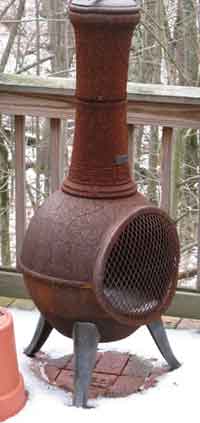
A Chiminea for Making Charcoal
I'd like to emphasize that, when I'm cooking charcoal in my fireplace as illustrated in some of these photos, I only cook loose, split whitewood, and I keep the wood a good half inch down from the lid. I don't want the wood to block the vent hole and cause pressure to build up in the retort. In general I prefer to cook charcoal over a fire outdoors because I think that is the safer practice. The last thing I want is a retort popping open and sending burning wood into my family room.
The vessel that the wood is heated in is called the retort, and it is the other major component of the process. In my fireplace, for a retort, I use a stainless steel stock pot with a stainless lid that I got from my grocery store. I have used this pot for numerous cookings, with no noticeable degradation of its quality other than a bit of warping of its bottom.
In my chiminea, I use a new, empty, one gallon paint can that I bought at Home Depot. Or, if I want to cook a small 2-3 ounce experimental batch of charcoal, I'll use a new quart can. I call that one the "quart retort." A new paint can will only cook 3-4 batches before the bottom begins to disintegrate. (Stop using it before this happens to prevent getting metal debris in your charcoal, which could cause sparks when ball milling the charcoal as a component of black powder compositions.)
To fill the large, stainless steel pot, I take 2x4 SPF wood scraps, cut them to the appropriate length, and split them into pieces about 3/4" square using a glove, an axe, and a log to split on. As I mentioned above, I like to cut the wood about a half inch shorter than the inside height of the retort.
I have found that the splitting works best for me when I place the axe on the end of the 2x4, lift both of them together, and then let them fall onto the splitting log. I've kept all my fingers with this method.
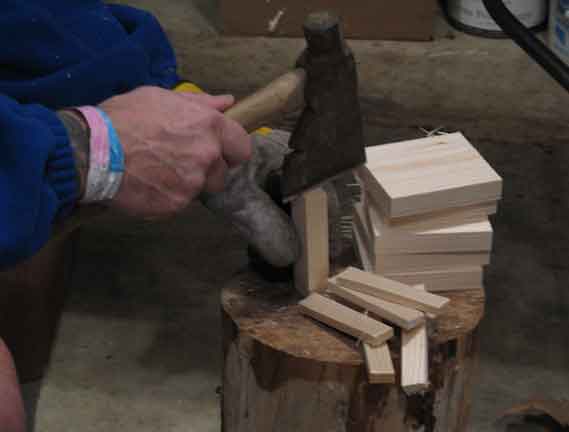
Splitting wood for the quart retort to make charcoal
Then I fill my retort with the split wood, keeping the wood about a half inch short of where the bottom of the lid will be.
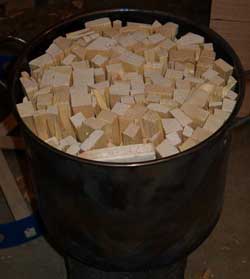
Stock pot filled with wood
To fill the quart retort, I bought a piece of pine 1x4, which was almost free of knots, from the Depot. Knots are much harder than the rest of the wood and, in general, it is best to eliminate as many of them as possible when cooking the wood into charcoal.
Now I secure the lid of the stock pot with little C-clamps purchased at Home Depot. There is a hole that I punched in the lid about 3/8" in diameter. If I am using the paint can, I simply install the lid securely after punching a quarter inch hole in the center of it with an awl. I don't use a drill on the lid, once again to avoid introducing metal shavings into the charcoal.
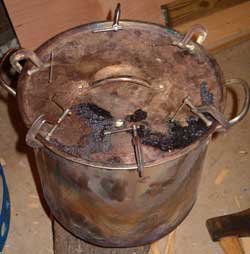
Lid secured on stock pot
After filling the retort, or before I start filling it, I build a good fire in my fire location. Then I put the pot in the middle of it, building the fire up around the sides of the pot and keeping the fire burning well by adding firewood as necessary.
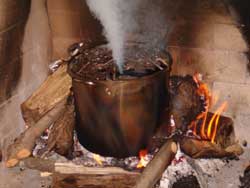
Pot on the fire
In a few minutes smoke and steam will start to vent out of the hole in the lid, increasing until there is a quite noisy plume coming out of the hole. One of the advantages of doing this in a fireplace, as opposed to doing it on a hot plate or gas burner, is that the flames consume the smoke and steam coming out of the retort, which otherwise, can be quite smelly and a potential bother for neighbors.
After a half hour or so, the white emission starts to become transparent and will catch fire, forming a little blowtorch emanating from the lid until the wood in the retort is done cooking.
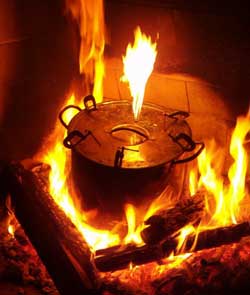
Stock pot emitting burning gasses
For the scientifically minded, this info is from Wikipedia:
Charcoal is the blackish residue consisting of impure carbon obtained by removing water and other volatile constituents from animal and vegetation substances. Charcoal is usually produced by heating wood, sugar, bone char, or others substances in the absence of oxygen (see char). The soft, brittle, lightweight, black, porous material resembles coal and is 85% to 98% carbon with the remainder consisting of volatile chemicals and ash.
I guess the initial smoky steam column is mostly water being driven off, and when the column becomes transparent and catches fire, the 'volatile constituents' are being forced out, leaving only the mostly carbon remains.
The paint pot usually takes about 1 to 1 1/2 hours to cook, while the stock pot takes 2 - 2 1/2 hours. The charcoal is done when the flaming gasses stop coming out of the lid of the retort. At that time the retort is removed from the fire and allowed to cool, usually overnight.
Some folks plug the vent hole in the retort lid with a stick, or cover it with a coin while the contents cool, to keep them from igniting and burning down to ash, since oxygen is being allowed in during cooling. I have not found this to be necessary, but I always keep the possibility in the back of my mind.
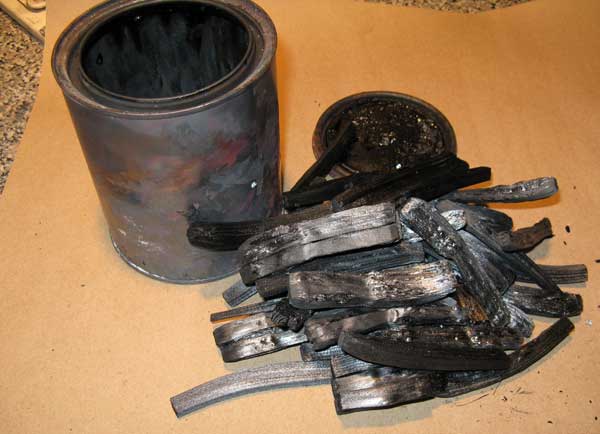
Cooked charcoal
After cooling, the lid and charcoal are removed from the retort. The charcoal can be broken up and smashed into small pieces by putting a small amount of it at a time into a 5 gallon plastic bucket and crushing it with a three foot length of 4x4 lumber.
This is a messy operation, to be done outdoors, with the wind blowing the dust away from you. And, I always wear a good respirator/dust-mask while doing it so that I don't breathe all that nasty dust.

The Big Smoosher
The crushed charcoal is poured from the large bucket into the small bucket, and the top of that bucket can be pinched into an oval for careful pouring of the contents into a ball mill jar for milling the charcoal into airfloat.
Or, if one needed some other mesh size of charcoal, say 80 mesh, the mashed charcoal could be screened through various sized screens to separate out the desired particle size.
Another option for smashing the cooked charcoal is shown in the photo below. This works very well for small quantities of charcoal. The corner of the square pan comes in handy when it comes time to pour its contents into the mill jar.
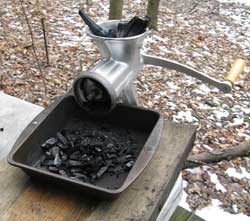
Grinding lump charcoal with a meat grinder
When I used the grinder for the first time, I ran some charcoal through it to remove any metal shavings or debris from the grinder, and I threw that charcoal away. I can't emphasize enough how important it is to me to keep any debris, which might cause sparks in the milling operation, out of my charcoal. I've heard of folks putting their charcoal in doubled plastic baggies and running over it with their car in the driveway to smash it up. All I can imagine is little bits of sand, dirt and gravel getting into the charcoal, which would be a bad thing.

Square pan pouring lumps into ball mill jar
I then ball mill the pieces for a couple of hours until airfloat charcoal is produced.
The stock pot yields about 3 pounds of charcoal and the paint can produces about a half pound, while the quart retort yields about 2 1/2 ounces.
The end result of this process is quality charcoal that is very useful in producing powerful black powder or charcoal streamer stars.
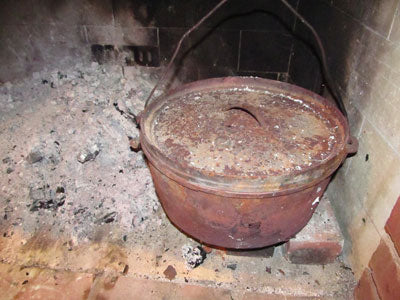
Cast-Iron Dutch Oven Charcoal-Cooking Retort
The heavy cast iron lids stay on simply due to gravity, so no clamps are necessary to keep the lids in place.
I do drill one 1/4-inch vent hole in the lid to vent the gasses during cooking.
Dutch ovens take and hold heat well, and radiate that heat evenly to the contents, for nice, even, quick charcoal cooking.
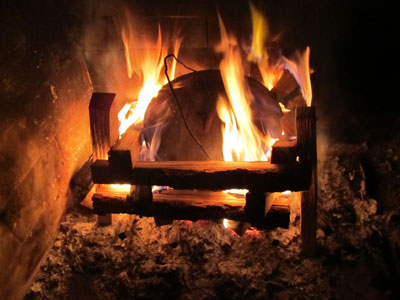
Cooking Charcoal in a Fireplace with a Dutch Oven Retort
Materials Needed
Which Wood to Use
On the various pyro discussion lists, one of the most often-heard conversations is about Charcoal. Many are searching for the Holy Grail of charcoals: That charcoal which will produce the fastest Black Powder, or the best sparks coming out of their stars and comets.For fast BP, one will often hear folks tout the qualities of Willow wood charcoal, or Alder Buckthorne, or Aspen, or Balsa. For good sparks, I've heard various woods recommended: apple, peach, pine root, pine, and others.
There is a really excellent article on making charcoal on the Passfire website, a resource I highly recommend for all of its informative articles. In that essay, the author discusses various woods that can be used in charcoal making, and settles on spruce/pine/fir (SPF) wood such as 2x4 scraps from house framing and the like. Sometimes this wood is referred to as whitewood. It is a softwood (conifer), as opposed to a hardwood (deciduous).
The advantage of these species is that the charcoal made from them can be used to make high quality Black Powder for lift and burst, and can also be used in charcoal stars where it produces nice, long-lasting spark trails. It's also a cheap, readily available wood. (In the Midwest, US, where I live, all of our 'white wood' framing lumber is either spruce or pine, so I can't claim to have any experience with using fir, which may be available out West. Yellow pine, which is used around here for 2x8,10, and12 framing lumber is not the same as the white wood spruce/pine. I don't think its charcoal is useful for us.)
I refer to the type of charcoal available here at Skylighter as Commercial Charcoal. My understanding is that this charcoal is made from mixed hardwoods: oak, ash, maple, and the like.
Commercial Charcoal can indeed be used to make perfectly serviceable Black Powder, stars, comets, and rockets. It may not make BP that is quite as powerful as that made with some of the homemade "designer" charcoals, but if a bit more of the BP is used it will work fine. It takes a bit of experimentation and testing to determine the final quantity to be used, and therein lies much of the pyro-fun for many of us.
After much of this R&D, when making homemade charcoal, I've determined that the SPF-whitewood suits my needs just fine for both black powder and sparks.
Making the Charcoal
Making charcoal is a simple, basic process which can be carried out at most homes and neighborhoods on a small scale. Large scale production is probably best done out in the country because there is a lot of smoke produced when cooking large quantities of wood. To cook charcoal, one simply needs some wood to cook, a fire, and a retort.We've already decided what wood we want to turn into charcoal.
A fire, such as that in a backyard fire pit, fireplace, or chiminea (one of those little pot-bellied stoves that many folks have out on their decks) is necessary.
A Chiminea for Making Charcoal
I'd like to emphasize that, when I'm cooking charcoal in my fireplace as illustrated in some of these photos, I only cook loose, split whitewood, and I keep the wood a good half inch down from the lid. I don't want the wood to block the vent hole and cause pressure to build up in the retort. In general I prefer to cook charcoal over a fire outdoors because I think that is the safer practice. The last thing I want is a retort popping open and sending burning wood into my family room.
The vessel that the wood is heated in is called the retort, and it is the other major component of the process. In my fireplace, for a retort, I use a stainless steel stock pot with a stainless lid that I got from my grocery store. I have used this pot for numerous cookings, with no noticeable degradation of its quality other than a bit of warping of its bottom.
In my chiminea, I use a new, empty, one gallon paint can that I bought at Home Depot. Or, if I want to cook a small 2-3 ounce experimental batch of charcoal, I'll use a new quart can. I call that one the "quart retort." A new paint can will only cook 3-4 batches before the bottom begins to disintegrate. (Stop using it before this happens to prevent getting metal debris in your charcoal, which could cause sparks when ball milling the charcoal as a component of black powder compositions.)
To fill the large, stainless steel pot, I take 2x4 SPF wood scraps, cut them to the appropriate length, and split them into pieces about 3/4" square using a glove, an axe, and a log to split on. As I mentioned above, I like to cut the wood about a half inch shorter than the inside height of the retort.
I have found that the splitting works best for me when I place the axe on the end of the 2x4, lift both of them together, and then let them fall onto the splitting log. I've kept all my fingers with this method.
Splitting wood for the quart retort to make charcoal
Then I fill my retort with the split wood, keeping the wood about a half inch short of where the bottom of the lid will be.
Stock pot filled with wood
To fill the quart retort, I bought a piece of pine 1x4, which was almost free of knots, from the Depot. Knots are much harder than the rest of the wood and, in general, it is best to eliminate as many of them as possible when cooking the wood into charcoal.
Now I secure the lid of the stock pot with little C-clamps purchased at Home Depot. There is a hole that I punched in the lid about 3/8" in diameter. If I am using the paint can, I simply install the lid securely after punching a quarter inch hole in the center of it with an awl. I don't use a drill on the lid, once again to avoid introducing metal shavings into the charcoal.
Lid secured on stock pot
After filling the retort, or before I start filling it, I build a good fire in my fire location. Then I put the pot in the middle of it, building the fire up around the sides of the pot and keeping the fire burning well by adding firewood as necessary.
Pot on the fire
In a few minutes smoke and steam will start to vent out of the hole in the lid, increasing until there is a quite noisy plume coming out of the hole. One of the advantages of doing this in a fireplace, as opposed to doing it on a hot plate or gas burner, is that the flames consume the smoke and steam coming out of the retort, which otherwise, can be quite smelly and a potential bother for neighbors.
After a half hour or so, the white emission starts to become transparent and will catch fire, forming a little blowtorch emanating from the lid until the wood in the retort is done cooking.
Stock pot emitting burning gasses
For the scientifically minded, this info is from Wikipedia:
Charcoal is the blackish residue consisting of impure carbon obtained by removing water and other volatile constituents from animal and vegetation substances. Charcoal is usually produced by heating wood, sugar, bone char, or others substances in the absence of oxygen (see char). The soft, brittle, lightweight, black, porous material resembles coal and is 85% to 98% carbon with the remainder consisting of volatile chemicals and ash.
I guess the initial smoky steam column is mostly water being driven off, and when the column becomes transparent and catches fire, the 'volatile constituents' are being forced out, leaving only the mostly carbon remains.
The paint pot usually takes about 1 to 1 1/2 hours to cook, while the stock pot takes 2 - 2 1/2 hours. The charcoal is done when the flaming gasses stop coming out of the lid of the retort. At that time the retort is removed from the fire and allowed to cool, usually overnight.
Some folks plug the vent hole in the retort lid with a stick, or cover it with a coin while the contents cool, to keep them from igniting and burning down to ash, since oxygen is being allowed in during cooling. I have not found this to be necessary, but I always keep the possibility in the back of my mind.
Cooked charcoal
After cooling, the lid and charcoal are removed from the retort. The charcoal can be broken up and smashed into small pieces by putting a small amount of it at a time into a 5 gallon plastic bucket and crushing it with a three foot length of 4x4 lumber.
This is a messy operation, to be done outdoors, with the wind blowing the dust away from you. And, I always wear a good respirator/dust-mask while doing it so that I don't breathe all that nasty dust.
The Big Smoosher
The crushed charcoal is poured from the large bucket into the small bucket, and the top of that bucket can be pinched into an oval for careful pouring of the contents into a ball mill jar for milling the charcoal into airfloat.
Or, if one needed some other mesh size of charcoal, say 80 mesh, the mashed charcoal could be screened through various sized screens to separate out the desired particle size.
Another option for smashing the cooked charcoal is shown in the photo below. This works very well for small quantities of charcoal. The corner of the square pan comes in handy when it comes time to pour its contents into the mill jar.
Grinding lump charcoal with a meat grinder
When I used the grinder for the first time, I ran some charcoal through it to remove any metal shavings or debris from the grinder, and I threw that charcoal away. I can't emphasize enough how important it is to me to keep any debris, which might cause sparks in the milling operation, out of my charcoal. I've heard of folks putting their charcoal in doubled plastic baggies and running over it with their car in the driveway to smash it up. All I can imagine is little bits of sand, dirt and gravel getting into the charcoal, which would be a bad thing.
Square pan pouring lumps into ball mill jar
I then ball mill the pieces for a couple of hours until airfloat charcoal is produced.
The stock pot yields about 3 pounds of charcoal and the paint can produces about a half pound, while the quart retort yields about 2 1/2 ounces.
The end result of this process is quality charcoal that is very useful in producing powerful black powder or charcoal streamer stars.
Retort Update
The best small retorts I've found, now, are cast iron Dutch ovens. They are available inexpensively from Harbor Freight, and last "forever."Cast-Iron Dutch Oven Charcoal-Cooking Retort
The heavy cast iron lids stay on simply due to gravity, so no clamps are necessary to keep the lids in place.
I do drill one 1/4-inch vent hole in the lid to vent the gasses during cooking.
Dutch ovens take and hold heat well, and radiate that heat evenly to the contents, for nice, even, quick charcoal cooking.
Cooking Charcoal in a Fireplace with a Dutch Oven Retort
Materials Needed
- Ball Mill (if making airfloat)
- Fire
- Retort
- Wood pieces