
How to Make Rocket Nozzle Mix
If you look in the end of most black powder rockets, or at the end of a gerb (fountain), you'll see a nozzle recessed into the end of the paper tube.

A Nozzle In Paper Tube
A nozzle is a mechanical device with an orifice (hole) in it, which controls and directs the flow of a liquid or gas as it passes through it. Think of the nozzle you put on the end of your garden hose. It controls the water flow, builds up higher pressure in the hose than would normally be there, and projects the water out in a nice stream. A rocket nozzle does essentially the same thing with the combustion gasses from the motor. This is what propels the rocket skyward.
Typically, the nozzle in a rocket, and the solid plug at the top of the rocket motor's fuel grain, is a rammed (hand pounded with a mallet) or pressed (with a hydraulic or mechanical rocket press) mixture of wax, clay, and grog. Some folks use only clay in their nozzles.
I did that for a while, but found that the clay was very susceptible to shrinkage/expansion, depending on the day's humidity. One time I pressed a bunch of wheel drivers with only bentonite clay nozzles, here in the Midwest hub of humidity. Then, when I got out to Gillette, Wyoming, which was so dry my lips started cracking, my nozzles got so loose in the tubes that I could turn them with my finger. (I quickly added a ring of Elmer's glue where the nozzle met the tube to secure them.)
Some folks expect their nozzle apertures to close a bit with the clay's expansion. So, right before flight, they open the hole up to the correct diameter with a hand-twisted drill bit. Wax makes the clay much less prone to this problem. Also, the clay alone, when pressed, forms a smooth, glossy surface; and nozzles and plugs have been known to get blown out of the tube by the pressure of the fuel burning. The grog in this mix really helps the nozzle 'bite' into the side of the tube and resist blowout.
The grog also helps the nozzle resist erosion of the hole during motor burn, whereas without the grog, the clay can wear away some and the nozzle aperture (hole) opens up some during the motor burn, which reduces pressure and thrust.
The technique I use to formulate these ingredients and mix them together is similar to the one David Sleeter recommends in his Amateur Rocket Motor Construction book.
I get the wax that I like to use from the canning supplies department of my grocery store. It reads "Household Paraffin Wax, for canning, candlemaking, and many other uses." (I'm not sure why they don't list rocket nozzles on the box as one of those uses. ;-)
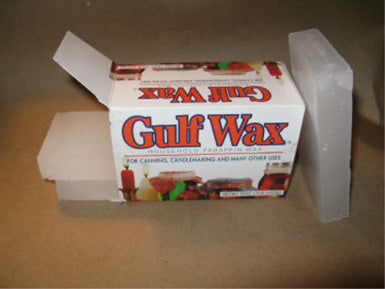
Paraffin Wax for Making Nozzles
I either use bentonite clay from Skylighter or Hawthorne Bond Fireclay. They are both very fine, powdered, dry clay. (When I first started making rockets, I imagined that 'clay' that should be like putty, or that I had to turn the dry clay powder into a 'play-dough' by adding water. We live and learn. No water is ever added to the clay.)
Grog is a man-made, sand-like product. It is made from fired pottery, crushed and screened. One well known rocket maker uses crushed red-clay flower pots. Another uses busted up and screened ceramic floor tile. I get my fine-medium grog from my local pottery supply house. Skylighter sells grog which has fine, medium and coarse (up to the size of peas) particles in it. To use that, I screen out the coarse grit to end up with something that looks like fine-medium sand. A fine-meshed kitchen screen colander works well for that.
For a batch of nozzle mix, I weigh out:
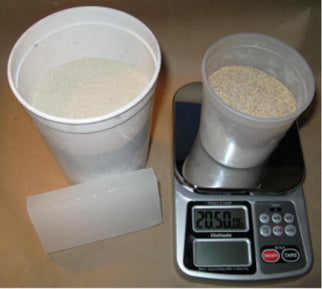
Weigh Your Clay and Grog
Now, I add the clay and grog to a new, clean, one-gallon paint can that I get at Home Depot. After installing the lid, I shake the can to mix the two powders. Then, I open the can, make an indentation in the center of the dry mix, and lay the block of wax in the indentation.
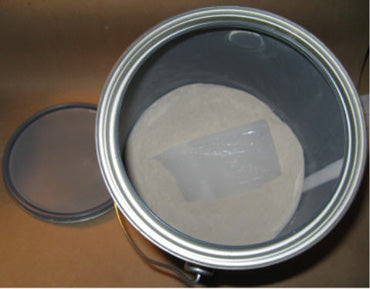
Place Block of Wax in Can with Clay/Grog Mix
I then lay the lid on the top of the can loosely. (Caution, do not put the lid on tight. Pressure can build up during the heating and either burst the can or pop the lid off, sending wax and clay everywhere, and possibly causing injury.) The can, with the loose lid, is then put in my oven, set at 250 degrees, and cooked for about 1-2 hours or until the wax is completely melted into the dry mix.
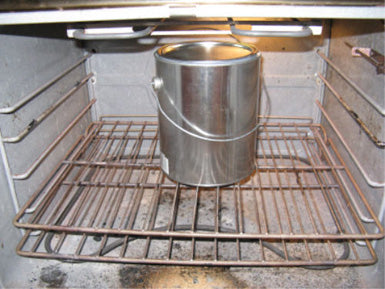
Heat Can at 250 o for 1-2 Hours
OK, OK. So my oven ain't so clean. I'll have to get on my wife, Molly, about that. Yeah, right. Oh, waitaminnit. That's the corn meal and cheese drippings from my pizza cooking on the bottom of it. Never Mind...
I don't use my kitchen oven lightly for this project. In fact this is the only time I do use it in my pyro pursuits-for cooking nozzle mix. I absolutely never use it to dry or heat any pyrotechnic compositions. Never. And I keep the heat in this process down at 250 degrees to prevent the wax from igniting. Puleez, be mindful and careful.
Once the wax has completely melted into the dry mix, you'll see that it has only dampened about half of the clay/grog. The other half is still dry. This is remedied by removing the can from the oven with oven mitts-believe me the whole rig is hot-removing the loose lid, and stirring all the ingredients with a paint stirring stick until the wax is well incorporated into the clay. During this stirring, I only grabbed the can without an oven mitt once.
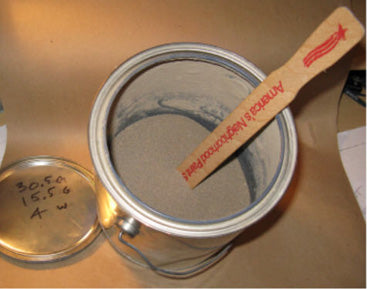
Mix Melted Wax with Clay/Grog Thoroughly
After stirring the mix with the stick, I install the lid, tightly this time, and, holding the can with oven mitts, shake the can violently to really incorporate the wax into the mix. Then, while the mix is still warm, I open the can and screen the mix through an old, wire mesh, kitchen colander onto kraft paper and let it cool down completely.

Screen Mix to Remove Lumps
This screening process really helps further integrate the wax into the mix, and also removes any waxy lumps which may form, which I just pitch out. The finished Nozzle Mix product will look like a tan, medium grained sand. I put it in an empty 5 lb. plastic chemical tub marked 'nozzle mix.'
I have another tub marked 'bulkhead mix.' This mix is the same as the nozzle mix, but with the grog portion simply replaced with more clay. I use this bulkhead mix in many driver and rocket motors, where I'm not concerned about needing the grog in the bulkhead (top clay plug) to prevent blowout. The advantage to this mix is that I can easily hand-twist a drill bit to create a passfire hole in the plug. If the mix had the grog in it, it would be very difficult to twist the bit through it, and the bit would get very dull quickly.
So, let's pound a nozzle up, remove it from the paper tube, and see just what sort of component this new nozzle mix will produce. Whaddaya say?
Using a Skylighter, one-pound, 1/4" wall rocket tube (TU1068), some one-pound rocket tooling (TL1211), a rawhide mallet (I swear by this mallet), and a 6 x 6 x 4 ft. tall 'pounding post,' I'll pound a nozzle into the tube, using a heaping 1/2 tablespoon measuring spoon and a funnel.
You might notice that black rubber O-Ring (from Home Depot) I like to use around my rocket tooling 'drifts.' Between Skylighter, Home Depot, and the kitchenwares department of my local department store, I get enough stuff to stay busy forever. The O-rings really help keep dust down. But my nozzle mix is not very dusty to begin with.
One nice tip, which I got from Tom D, is to soak the rocket tubes in Minwax Wood Hardener and let them dry. This will strengthen the tubes and make them more fire-resistant. I'll dip the tubes into a can of the hardener, let them set there for a minute, remove them, and stand them on end on some plywood scrap to dry.
8-12 nice whacks with the mallet and the nozzle mix is well consolidated. Now, to dissect this nozzle a bit, I use a coping saw to cut the paper tube off right above the nozzle, and slice the tube on both sides of the clay. You can see how the nozzle mix has consolidated into a solid mass, bulging the inside of the tube out just a bit in the process, which really locks the nozzle into the tube.
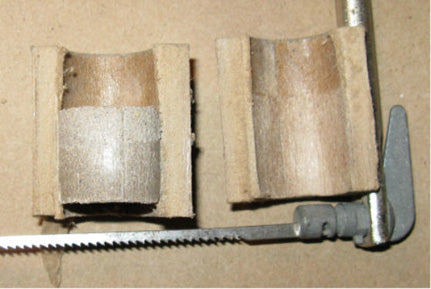
Cross Section of Cardboard Tube Showing Nozzle
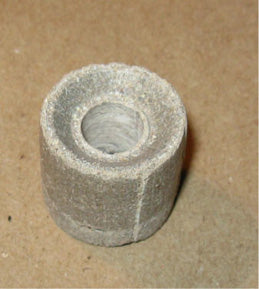
Nozzle Removed from Tube
If you tap a metal spoon against the side of the clay nozzle, it 'tinks' like a little piece of solid ceramic. Nice.
In the future, we'll have an article on how to build a one-pound, black powder, charcoal-tailed rocket based on the foundation that has been laid in this article. One really nice thing about these rockets is that they provide great pyro and immediate-gratification, even in the winter months. Make up some nozzle mix, blend together some fuel, pound a motor together, attach it to a stick, and take 'er outside to fly. Smell the Smoke.
Have fun and Stay Green,
Ned
Materials Needed
A Nozzle In Paper Tube
A nozzle is a mechanical device with an orifice (hole) in it, which controls and directs the flow of a liquid or gas as it passes through it. Think of the nozzle you put on the end of your garden hose. It controls the water flow, builds up higher pressure in the hose than would normally be there, and projects the water out in a nice stream. A rocket nozzle does essentially the same thing with the combustion gasses from the motor. This is what propels the rocket skyward.
Typically, the nozzle in a rocket, and the solid plug at the top of the rocket motor's fuel grain, is a rammed (hand pounded with a mallet) or pressed (with a hydraulic or mechanical rocket press) mixture of wax, clay, and grog. Some folks use only clay in their nozzles.
I did that for a while, but found that the clay was very susceptible to shrinkage/expansion, depending on the day's humidity. One time I pressed a bunch of wheel drivers with only bentonite clay nozzles, here in the Midwest hub of humidity. Then, when I got out to Gillette, Wyoming, which was so dry my lips started cracking, my nozzles got so loose in the tubes that I could turn them with my finger. (I quickly added a ring of Elmer's glue where the nozzle met the tube to secure them.)
Some folks expect their nozzle apertures to close a bit with the clay's expansion. So, right before flight, they open the hole up to the correct diameter with a hand-twisted drill bit. Wax makes the clay much less prone to this problem. Also, the clay alone, when pressed, forms a smooth, glossy surface; and nozzles and plugs have been known to get blown out of the tube by the pressure of the fuel burning. The grog in this mix really helps the nozzle 'bite' into the side of the tube and resist blowout.
The grog also helps the nozzle resist erosion of the hole during motor burn, whereas without the grog, the clay can wear away some and the nozzle aperture (hole) opens up some during the motor burn, which reduces pressure and thrust.
The technique I use to formulate these ingredients and mix them together is similar to the one David Sleeter recommends in his Amateur Rocket Motor Construction book.
I get the wax that I like to use from the canning supplies department of my grocery store. It reads "Household Paraffin Wax, for canning, candlemaking, and many other uses." (I'm not sure why they don't list rocket nozzles on the box as one of those uses. ;-)
Paraffin Wax for Making Nozzles
I either use bentonite clay from Skylighter or Hawthorne Bond Fireclay. They are both very fine, powdered, dry clay. (When I first started making rockets, I imagined that 'clay' that should be like putty, or that I had to turn the dry clay powder into a 'play-dough' by adding water. We live and learn. No water is ever added to the clay.)
Grog is a man-made, sand-like product. It is made from fired pottery, crushed and screened. One well known rocket maker uses crushed red-clay flower pots. Another uses busted up and screened ceramic floor tile. I get my fine-medium grog from my local pottery supply house. Skylighter sells grog which has fine, medium and coarse (up to the size of peas) particles in it. To use that, I screen out the coarse grit to end up with something that looks like fine-medium sand. A fine-meshed kitchen screen colander works well for that.
For a batch of nozzle mix, I weigh out:
- One of the 4 ounce wax blocks from the box
- 30.5 ounces of the clay
- 15.5 ounces of the grog
- 30.5 ounces of the clay
- 15.5 ounces of the grog
Weigh Your Clay and Grog
Now, I add the clay and grog to a new, clean, one-gallon paint can that I get at Home Depot. After installing the lid, I shake the can to mix the two powders. Then, I open the can, make an indentation in the center of the dry mix, and lay the block of wax in the indentation.
Place Block of Wax in Can with Clay/Grog Mix
I then lay the lid on the top of the can loosely. (Caution, do not put the lid on tight. Pressure can build up during the heating and either burst the can or pop the lid off, sending wax and clay everywhere, and possibly causing injury.) The can, with the loose lid, is then put in my oven, set at 250 degrees, and cooked for about 1-2 hours or until the wax is completely melted into the dry mix.
Heat Can at 250 o for 1-2 Hours
OK, OK. So my oven ain't so clean. I'll have to get on my wife, Molly, about that. Yeah, right. Oh, waitaminnit. That's the corn meal and cheese drippings from my pizza cooking on the bottom of it. Never Mind...
I don't use my kitchen oven lightly for this project. In fact this is the only time I do use it in my pyro pursuits-for cooking nozzle mix. I absolutely never use it to dry or heat any pyrotechnic compositions. Never. And I keep the heat in this process down at 250 degrees to prevent the wax from igniting. Puleez, be mindful and careful.
Once the wax has completely melted into the dry mix, you'll see that it has only dampened about half of the clay/grog. The other half is still dry. This is remedied by removing the can from the oven with oven mitts-believe me the whole rig is hot-removing the loose lid, and stirring all the ingredients with a paint stirring stick until the wax is well incorporated into the clay. During this stirring, I only grabbed the can without an oven mitt once.
Mix Melted Wax with Clay/Grog Thoroughly
After stirring the mix with the stick, I install the lid, tightly this time, and, holding the can with oven mitts, shake the can violently to really incorporate the wax into the mix. Then, while the mix is still warm, I open the can and screen the mix through an old, wire mesh, kitchen colander onto kraft paper and let it cool down completely.
Screen Mix to Remove Lumps
This screening process really helps further integrate the wax into the mix, and also removes any waxy lumps which may form, which I just pitch out. The finished Nozzle Mix product will look like a tan, medium grained sand. I put it in an empty 5 lb. plastic chemical tub marked 'nozzle mix.'
I have another tub marked 'bulkhead mix.' This mix is the same as the nozzle mix, but with the grog portion simply replaced with more clay. I use this bulkhead mix in many driver and rocket motors, where I'm not concerned about needing the grog in the bulkhead (top clay plug) to prevent blowout. The advantage to this mix is that I can easily hand-twist a drill bit to create a passfire hole in the plug. If the mix had the grog in it, it would be very difficult to twist the bit through it, and the bit would get very dull quickly.
So, let's pound a nozzle up, remove it from the paper tube, and see just what sort of component this new nozzle mix will produce. Whaddaya say?
Using a Skylighter, one-pound, 1/4" wall rocket tube (TU1068), some one-pound rocket tooling (TL1211), a rawhide mallet (I swear by this mallet), and a 6 x 6 x 4 ft. tall 'pounding post,' I'll pound a nozzle into the tube, using a heaping 1/2 tablespoon measuring spoon and a funnel.
You might notice that black rubber O-Ring (from Home Depot) I like to use around my rocket tooling 'drifts.' Between Skylighter, Home Depot, and the kitchenwares department of my local department store, I get enough stuff to stay busy forever. The O-rings really help keep dust down. But my nozzle mix is not very dusty to begin with.
One nice tip, which I got from Tom D, is to soak the rocket tubes in Minwax Wood Hardener and let them dry. This will strengthen the tubes and make them more fire-resistant. I'll dip the tubes into a can of the hardener, let them set there for a minute, remove them, and stand them on end on some plywood scrap to dry.
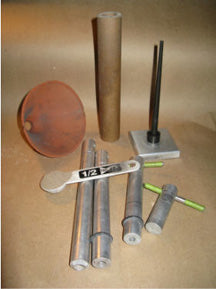 Rocket Tooling - Note Black O-Rings |
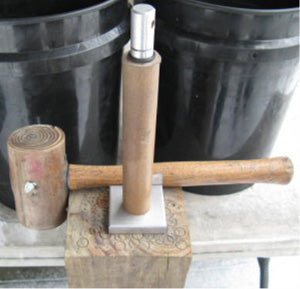 Ram Mix into Tube with Nozzle Forming Tool and Mallet |
8-12 nice whacks with the mallet and the nozzle mix is well consolidated. Now, to dissect this nozzle a bit, I use a coping saw to cut the paper tube off right above the nozzle, and slice the tube on both sides of the clay. You can see how the nozzle mix has consolidated into a solid mass, bulging the inside of the tube out just a bit in the process, which really locks the nozzle into the tube.
Cross Section of Cardboard Tube Showing Nozzle
Nozzle Removed from Tube
If you tap a metal spoon against the side of the clay nozzle, it 'tinks' like a little piece of solid ceramic. Nice.
In the future, we'll have an article on how to build a one-pound, black powder, charcoal-tailed rocket based on the foundation that has been laid in this article. One really nice thing about these rockets is that they provide great pyro and immediate-gratification, even in the winter months. Make up some nozzle mix, blend together some fuel, pound a motor together, attach it to a stick, and take 'er outside to fly. Smell the Smoke.
Have fun and Stay Green,
Ned
Materials Needed
- Bentonite clay (CH8078)
- Funnel
- Grog (CH8058)
- Measuring spoons
- One-gallon paint can
- Oven
- Paraffin wax
- Rawhide Mallet
- Rocket Tooling, One-pound (TL1211)
- Rocket Tube (TU1068)
- Scale