
How To Make Senko Hanabi Sparklers
Introduction
In the past, I've kiddingly told fellow pyros that, at one time or another, I've made, or at least have tried to make, every kind of fireworks device except for snakes. That was before I heard about Senko Hanabi, though, and realized that I didn't even know what they are.I've made some sparklers in years past, and Senko Hanabi are a kind of Japanese sparkler in the strict sense of the word. But, after a friend gave some of them to me last year, I realized I'd never tried to make anything like them.
According to Shimizu in Fireworks, the Art, Science and Technique ("FAST"), Senko Hanabi is a traditional Japanese firework, and essays about them date back to at least 1927. One Japanese-to-English, online dictionary spells it Senkouhanabi, and defines the word as "toy fireworks." Hanabi means "flowers of fire," and these sparklers produce miniature versions of them.
Senko is defined as "all ages," and perhaps refers to the fact that this firework can be enjoyed by people of all ages. Senkou is said to refer to "incense stick" and this type of sparkler has, indeed been made on sticks, which resemble incense.
The word "sparkler" may be a bit misleading to us in the USA, though, because of what it brings to mind. Metal wires or wood sticks, dipped in pyrotechnic compositions, emitting bright sparks and lots of heat when they burn. "Be careful around your sister's eyes with that glowing metal wire," Mom would shout.
This Japanese version of the sparkler is much more delicate and subtle than what we are used to, though and a lot more safe as well. I remember how startled I felt when I first got one of these to work, and it began emitting amazingly complex, delicate, branching sparks, shooting out four to eight inches. Like fire-snowflakes, I thought. I was amazed.
After I burned through a pack of them, I decided to send my Mom and Dad a bundle of these colorful little sticks. My folks are in their 80's and live in California, so I certainly wouldn't have been comfortable sending them any real "fireworks," but I just had to show them these mysterious little sparklers. I was excited as I imagined them going out onto their deck and burning a few of 'em.
"You are going to be amazed by what you see when these little things really start doing their thing," I told them.
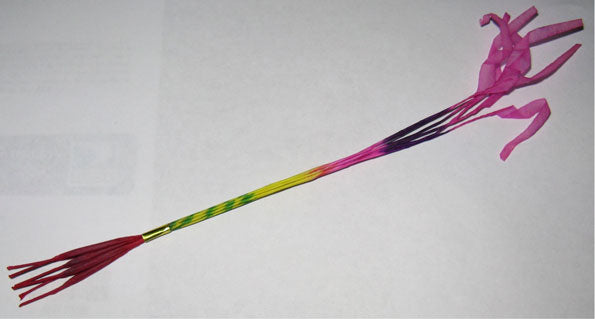
A Bundle of Senko Hanabi Sparklers
Dissection of a Senko Hanabi
Here's a photo of an individual Senko Hanabi.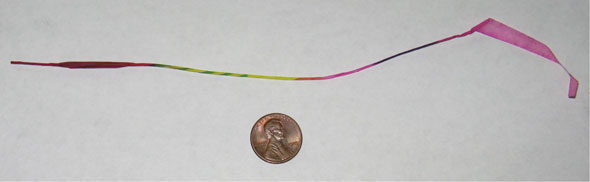
One Senko Hanabi Sparkler
The bulging section toward the left end is what contains the sparkler composition. The comp is contained in twisted tissue paper, which can be fairly easily untwisted to empty the contents.
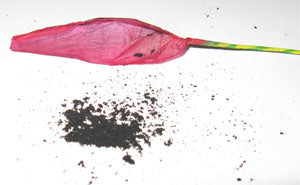
Senko Hanabi Composition Removed From Sparkler
The composition is a very dark black powder. And there is not much of it in there. I have an electronic scale, which is precise to one-tenth of a gram. It would not register the weight of the composition that I removed from this sparkler. It barely covered the tip of a one-eighth teaspoon measuring spoon. Its quantity equals about as much salt as you'd get if you shook your salt shaker a couple of times.
The rest of the sparkler, the handle, is also composed of tightly rolled up tissue paper. It feels as though it has been stiffened with a bit of a binder or glue of some sort.
Lighting a Senko Hanabi To get a Senko Hanabi to work, you hang the composition end of it straight down from your hand. Make sure you are in an area with no wind, steady your hand, and then light that lower end. To really see the effect, it's best to do this in the dark, and in a ventilated area, but without wind, so you don't have to breathe the strong sulfur smoke.
The tip will burn up to the bundle of composition, which will begin to slowly burn, and if you are holding it still enough, a little blob of orange, glowing, molten slag will form. This is reportedly potassium sulfide, which contains carbon from the charcoal.
Then, all of a sudden, this molten ball will begin to emit the most amazing, delicate, branching sparks, often looking like fire-snowflakes. When you see this for the first time you'll be amazed.
I tried, over and over, to get a nice photograph of this phenomenon and failed miserably. This shot might give you the slightest impression of what the effect is like. You really have to see it in person to appreciate it.
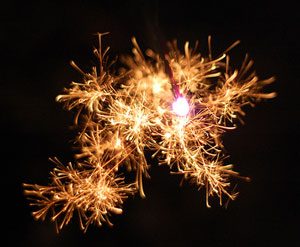
Burning Senko Hanabi Sparkler
How to Make a Senko Hanabi Sparkler
There are several Senko Hanabi tutorials available on the Internet, and, as far as I can tell, all the information is based on the information contained in Shimizu's FAST.The black composition is a simple one, consisting of three basic chemicals: potassium nitrate, sulfur, and charcoal.
These are combined in a ratio of 60% potassium nitrate, 20-30% sulfur, and 10-20% charcoal. This is a typical black powder composition, but the quantity of the sulfur is doubled or even tripled.
Sometimes lampblack or soot is used instead of charcoal. If charcoal is used, the type of charcoal will influence the resulting sparks. Some folks use charcoal that is made of tissue paper or paper towel, soaked in a sugar solution, and cooked in a retort until it becomes a form of charcoal. See my Charcoal Making Secrets article.
Shimizu also lists an alternate composition, consisting of 35% potassium nitrate, 45% realgar, and 20% charcoal or soot. Realgar is a chemical that is listed as a component of some old fireworks formulae, but it is seldom used nowadays because it has become unavailable, and it contains arsenic, which can be a bad thing in smoke if it is inhaled!
Note: I do have a small quantity of realgar, and I tried the above formula in Senko Hanabi. Shimizu states that realgar will produce "larger and more beautiful sparks than with sulfur." In the minimal experimenting I performed using it, I did not find that it performed as well as the sulfur. And, when the composition burns, it emits a thick, yellow smoke, which I was not all that thrilled to be around.
My technique for making these experimental Senko Hanabi was as follows:
Weigh out chemicals in individual paper cups. Grind potassium nitrate and sulfur individually in a small coffee grinder until the chemicals are very fine. Combine and screen those chemicals with the airfloat charcoal through a 100-mesh screen several times.
I began by using 16.5 grams of the potassium nitrate, 6.5 grams of sulfur, and 4.5 grams of airfloat charcoal. (This is approximately a 60/25/15 proportion of the components.)
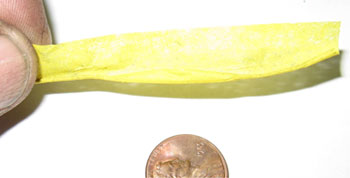
Cut a piece of tissue paper, 1/2" x 2 1/2".
With slightly dampened thumbs and index fingers, begin to roll the tissue paper up at the ends, as if I'm rolling a cigarette. (Having come of age in the 60's and 70's, I, of course, would know nothing about this process.)
 |
 |
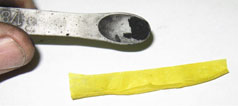
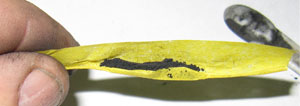
I now dip the end of my 1/8-teaspoon, measuring spoon in my composition and scoop out just that little bit of comp. I tap the powder out of the spoon into the little, rolled trough that was formed in my tissue paper.
 |
 |
Then it's just a matter of using my fingers to finish rolling the little sparkler and really twisting it into a tight little bundle. I like to hold my homemade sparkler with a pair of tweezers, or a hemostat, in preparation for burning it.
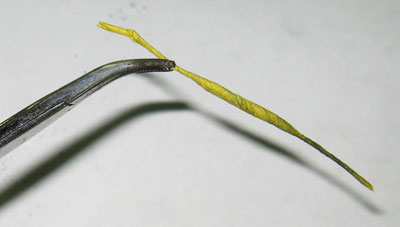
Homemade Senko Hanabi Ready to be Lit and Tested
Results of Experiments
When I made the first sparklers, using the composition listed above, they burned far too fast and did not form the little ball of slag which is necessary for the resulting final sparks to let fly.So, I started to add more charcoal, one half gram at a time, as one would do to slow down a black powder rocket composition. This did end up retarding the burn speed, but the slag ball and the sparks never ended up forming.
Back to the drawing board. Since the original comp was burning too rapidly, I thought I'd start with the charcoal and sulfur components, and slowly add potassium nitrate until hopefully the desired results were achieved.
I ground the 6.5 grams of sulfur in my small coffee mill, and screened it in with my 4.5 grams of charcoal. I weighed out the 16.5 grams of potassium nitrate and milled it by itself in the coffee mill.
Then I started to add the potassium nitrate to the sulfur/charcoal mix a little at a time, starting with 4 grams and adding it in 1-gram increments. I tested the composition after each increase in the oxidizer, and after adding 11 grams of it, the ball of slag started to form and it began emitting the sparks I was after.
With a total of 12 grams of the potassium nitrate in the mix, the sparklers were working very well, and when I added another gram bringing the total to 13 grams, they started to burn too quickly as in my first experiments.
So the final working formula was:
| Component | Parts | Percent |
| Potassium Nitrate | 12 | 52% |
| Charcoal | 4.5 | 20% |
| Sulfur | 6.5 | 28% |
| Totals | 23 | 100% |
This final formula is in the range of proportions that Shimizu demonstrated to work.
I tried both commercial airfloat and homemade spruce/pine airfloat charcoals, and they both worked well. The homemade charcoal produced sparks which were slightly larger.
I tried the lampblack that I had on hand in the formula, instead of charcoal, but I could not get it to work and produce sparks.
If I were going to make "production models" of these babies, I'd glue the tissue paper bundles to a bamboo skewer, or toothpick, handle.
Dr. Shimizu goes into much greater detail concerning the chemistry dynamics of the Senko Hanabi process, and other optional formulae, ingredients, and manufacturing processes.
When I first got into fireworking, one question was paramount in my mind: "How the heck do they do that?" I've continued to ask that about almost every pyrotechnic device I've seen, and I'm glad that Dr. Shimizu and others have left pointers along the way so that I could learn more about how these things are made.
Until next time, Enjoy!
Ned
Materials Needed
- Charcoal
- Coffee Grinder
- Potassium Nitrate
- Screen, 100-mesh
- Sulfur
- Tissue Paper