
How to Make Strontium Nitrate Sparklers
The very popular fireworks making book, Introductory Practical Pyrotechnics provides a neat project for making sparklers. Problem is, we couldn't ship barium nitrate for a long time. What to do? Here's a project formulae for making sparklers that doesn't need either barium nitrate or potassium perchlorate. Thanks to one of our readers, who wishes to remain anonymous.
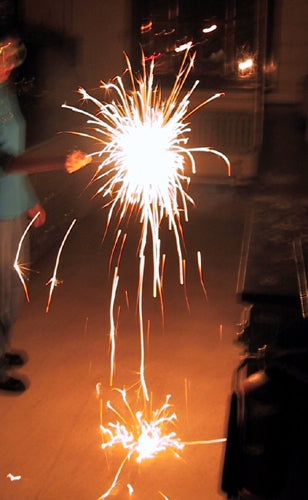
A Sparkler Made with Strontium Nitrate
Grind unground components (if any) separately. Mix together all your sparklers components except dextrin. Add 25 ml of 25% aqueous ethanol (25% alcohol, 75% water) to dextrin and stir until it becomes a paste. Break up or discard any large clumps that form in your sparklers paste. Add paste to dry sparklers components and stir. Add 65 ml more ethanol solution, with stirring. Dump your sparklers mixture into 41 mm OD x 12" long test tube (or pipe, whatever). The wet sparklers composition should be 7" to 8" deep.
Dip sparklers stick (or wire/whatever) into mix and let dry 24 hours. Then apply 2 more coats in same manner. If needed, add about 5 ml ethanol solution to re-wet mix. Let your sparklers for dry 24-48 hours.
The slag created when you dip the sparklers is fun to let dry in a pile and light on fire on the ground, too.
Notes:
The sparklers formula isn't mine originally--I just modified it slightly. Hopefully this will give you something to tell the people that whine they can't make sparklers without perchlorates. I've actually tried several formulations, including those with perchlorates, and the ones with perchlorates burn too fast, too erratically, and a little too energetically for using as a full coating on the sparklers.
A Sparkler Made with Strontium Nitrate
Strontium Nitrate Steel Sparklers
| Component: | Parts: |
| Strontium nitrate (CH5543) | 200 grams |
| Sparkler-grade (or any other) steel powder (CH8300) | 120 grams |
| Aluminum, bright flake, -325 mesh (CH0174 or CH0178) | 32 grams |
| Airfloat Charcoal (CH8068) | 2 grams |
| Boric Acid (CH8042) | 6 grams |
| Dextrin (CH8107) | 40 grams |
| +90 ml 25% aqueous ethanol (alcohol) solution | |
Grind unground components (if any) separately. Mix together all your sparklers components except dextrin. Add 25 ml of 25% aqueous ethanol (25% alcohol, 75% water) to dextrin and stir until it becomes a paste. Break up or discard any large clumps that form in your sparklers paste. Add paste to dry sparklers components and stir. Add 65 ml more ethanol solution, with stirring. Dump your sparklers mixture into 41 mm OD x 12" long test tube (or pipe, whatever). The wet sparklers composition should be 7" to 8" deep.
Dip sparklers stick (or wire/whatever) into mix and let dry 24 hours. Then apply 2 more coats in same manner. If needed, add about 5 ml ethanol solution to re-wet mix. Let your sparklers for dry 24-48 hours.
The slag created when you dip the sparklers is fun to let dry in a pile and light on fire on the ground, too.
Notes:
- You may have to adjust the volume of ethanol solution to make the sparklers paste consistency right; it seems to be slightly more or less every time I do it.
- Sparklers may be difficult to light. Propane torches or those butane cigarette lighters held on the sparklers for a minute tend to do well. Sparklers can also be lit off each other. I sometimes use a prime just for the tip of the sparklers that uses perchlorate [or try a black powder/dextrin slurry].
- When the sparklers slag dries, you can notice rust from the steel. This may indicate that coating the steel with linseed oil first may be the way to go, though I haven't ever had any problems with it. These sparklers were made in the Missouri summer, so they had plenty of humidity around.
- The paste for the sparklers can come out a bit clumpy. Larger batches will even out the sparklers coatings a bit. I haven't tried, but thorough mechanical mixing once slurried would probably help, too. It doesn't affect the sparklers' burning at all.
The sparklers formula isn't mine originally--I just modified it slightly. Hopefully this will give you something to tell the people that whine they can't make sparklers without perchlorates. I've actually tried several formulations, including those with perchlorates, and the ones with perchlorates burn too fast, too erratically, and a little too energetically for using as a full coating on the sparklers.