
Veline Fireworks Stars Color System
Robert Veline created this fireworks star system and intentionally put it in the public domain. When you look at it, you can see that it uses very similar firework chemical ingredients and proportions for many of the different fireworks star colors, making this an extremely versatile fireworks star color set: you can create any color you want using only ten firework chemicals!
When you look at the part called "Now the Fun Stuff" you can even see how to mix an almost limitless palette of fireworks star colors by mixing the different primary fireworks star colors shown in the table. A word to the wise: These fireworks star colors are well balanced in terms of color brightness and intensity. So, Veline's fireworks star colors seem to appear most pleasing when they are used with each other in any given device (artillery shell, mine, etc.). Here's the original paper published by Veline, but formatted slightly different.
A Compatible Star Formula System for Color Mixing
By Robert Veline
A Few Notes About These Fireworks Star Formulas
The numbers are in percent by weight. The potassium perchlorate is a fine powder. The parlon was Hercules brand, but Superchlon brand from Ishihara Co. Ltd. also works. Nothing special about the red gum, just fine powder. The best barium and strontium carbonates are obtained from Barium and Chemicals of Steubenville Ohio. The calcium carbonate was -200 mesh 'Whiting'. Copper carbonate may be used rather than black copper oxide without much change in performance. I have tried finer more pure forms and found they have slowed the burn rate, and degraded the fireworks star color... Note that all of the proportions are the same for the different fireworks star colors, the exception being the green. The idea is to have as many characteristics, burn rate, brightness, flame size, color purity, and density of powder, common between the different powders, as is possible. While these formulas do not excel in any one characteristic, they are all part of a matched set. The green: I was unable to get a suitable green fireworks star for this family without using barium nitrate. So, in order to compensate for the reduced oxidizing ability of the nitrate, a more energetic fuel mixture was used.
Now the Fun Stuff:
Copyright: Robert Veline
Well, that's it! These fireworks stars are the results of a couple of years of hard work, they are offered as some form of repayment to the many people who published information which I have feasted on all these years. THANK YOU!!!! Robert Veline II
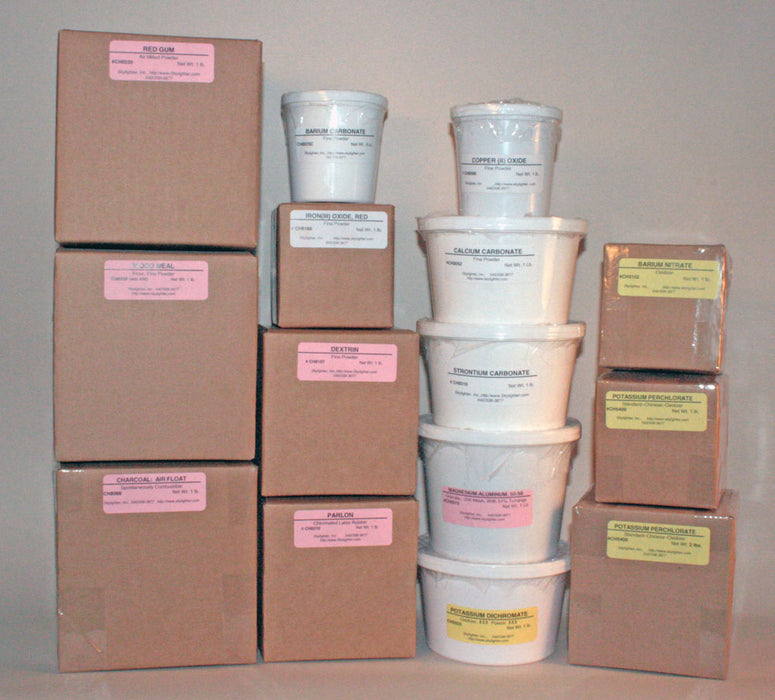
All the chemicals you'll need to make more then 4 lbs. of brilliantly colored stars + 1 lb. of hot prime.
When you look at the part called "Now the Fun Stuff" you can even see how to mix an almost limitless palette of fireworks star colors by mixing the different primary fireworks star colors shown in the table. A word to the wise: These fireworks star colors are well balanced in terms of color brightness and intensity. So, Veline's fireworks star colors seem to appear most pleasing when they are used with each other in any given device (artillery shell, mine, etc.). Here's the original paper published by Veline, but formatted slightly different.
A Compatible Star Formula System for Color Mixing
By Robert Veline
| Red | Orange | Green | Blue | Super Prime | |
| Strontium Carbonate | |||||
| Calcium Carbonate | |||||
| Barium Carbonate | |||||
| Copper oxide, black | |||||
| Barium nitrate | |||||
| Potassium Perchlorate | |||||
| Parlon | |||||
| Red Gum | |||||
| Magnalium (50/50 -200 mesh) |
|||||
| Dextrin | |||||
| Charcoal Airfloat | |||||
| Wood Meal, -70 mesh | |||||
| Iron Oxide, Red | |||||
| Potassium Dichromate |
Are you fixing to make a batch of Veline System stars, but don't want to calculate the ratios for your batch size?
Well, one of the Skylighter faithful did all the math for you and provided an MS Excel sheet that calculates all the details in an instant. Just select the color, and enter your batch size and it does all the work for you.
Free Download Here: Veline System Calculator
Well, one of the Skylighter faithful did all the math for you and provided an MS Excel sheet that calculates all the details in an instant. Just select the color, and enter your batch size and it does all the work for you.
A Few Notes About These Fireworks Star Formulas
The numbers are in percent by weight. The potassium perchlorate is a fine powder. The parlon was Hercules brand, but Superchlon brand from Ishihara Co. Ltd. also works. Nothing special about the red gum, just fine powder. The best barium and strontium carbonates are obtained from Barium and Chemicals of Steubenville Ohio. The calcium carbonate was -200 mesh 'Whiting'. Copper carbonate may be used rather than black copper oxide without much change in performance. I have tried finer more pure forms and found they have slowed the burn rate, and degraded the fireworks star color... Note that all of the proportions are the same for the different fireworks star colors, the exception being the green. The idea is to have as many characteristics, burn rate, brightness, flame size, color purity, and density of powder, common between the different powders, as is possible. While these formulas do not excel in any one characteristic, they are all part of a matched set. The green: I was unable to get a suitable green fireworks star for this family without using barium nitrate. So, in order to compensate for the reduced oxidizing ability of the nitrate, a more energetic fuel mixture was used.
Now the Fun Stuff:
| YELLOW | 55 green | 45 orange | ||
| CHARTREUSE | 80 green | 20 Orange | ||
| AQUA | 80 green | 20 Blue | ||
| TURQUOISE | 55 green | 45 Blue | ||
| MAGENTA | 50 red | 50 Blue | ||
| MAROON | 85 red | 15 Blue | ||
| PEACH | 60 orange | 25 red | 15 blue | |
| PURPLE | 5 orange | 15 red | 80 blue |
Copyright: Robert Veline
Well, that's it! These fireworks stars are the results of a couple of years of hard work, they are offered as some form of repayment to the many people who published information which I have feasted on all these years. THANK YOU!!!! Robert Veline II
Veline Color Stars Kit

Check Out the Kit & Order Here