
Planning a Consumer Fireworks Display
Introduction
The Fourth of July is just around the corner, and many of us really enjoy producing a nice fireworks display to entertain our family and friends, and to show off our pyro talents.For many years a buddy of mine has hosted a large party, with a hog-roast and a bonfire, which has brought in hundreds of folks. I've presented a fireworks show annually at this event to cap off the festivities.
There's nothing quite like putting in many hours of work and to have it result in that many people-adults and children-sitting in rapt awe as the show goes on, and erupting in joyful cheering at its completion.
I've had many folks compliment these small shows, comparing them favorably with the huge, commercial, downtown displays on the river. There's just something about a small, intimate, family-and-friends setting, ending up with a nicely planned pyro display, all resulting in a really memorable event.
In the end, this demonstration of our pyrotechnic creativity, talent, hard work, and experience, and the entertaining of others with all of it, is really what this art form is all about.
To insure a safe and successful consumer fireworks display, there are some topics which merit consideration in the planning process:
- What are the laws governing such a display in my particular state, county, or city? Is there a requirement to have insurance for such a show?
- What is the site like where the display is to be presented? What sorts of fireworks devices will be appropriate and safe at that site?
- What is the budget for the show? Who will be paying for the fireworks, and when?
- Will the display be shot with accompanying music or not?
- Will the display be fired by hand, electrically, or with a combination of the two?
- Who will be helping with the display?
- What will be the length of the show?
- What devices will be employed in the show, and how will they be laid out at the site?
- What safety precautions are necessary?
- Will there be any reloading of devices during the show?
- How can we prepare for inclement weather?
It's quite amazing how much work there is to be done on the day of the show. If the above topics are addressed beforehand, and if enough work is done before the day of the show, then the chances of a safe, successful and enjoyable show are greatly improved.
Legalities
This ain't a fun subject, but it might be the one which can save you a lot of heartbreak and wasted money.In the USA, there is no federal law regulating the use of consumer fireworks, only their production and sale.
But laws vary widely from state to state, and from locality to locality. In my state of Ohio, the display of all but "safe and sane" consumer fireworks is illegal. But around the Fourth of July many local law enforcement agencies look the other way unless they get a lot of complaints from neighbors.
In some other states anything goes. In others if you fire off a bottle rocket you'll end up in the slammer pretty quickly, have all your fireworks confiscated and perhaps your car and home as well.
Only you can research your state and local laws, and determine for yourself what you can and cannot do.
Here in Ohio, I've chosen to get my state fireworks display operator's license, to procure the necessary fireworks display permits, and to have a certificate of insurance for any display I produce. This gets the authorities-having-jurisdiction (AHJ's) on my side, and I avoid having to be looking over my shoulder and waiting for the cop cars to pull up during the show.
And, if God forbid, there's any property damage or injury, my permit and insurance are there to back me up.
The Display Site
Where will I be shooting the display? How big is the area; where will the spectators be; how close are the nearest structures and trees; how dry is the surrounding vegetation; and what sorts of devices will be safe to display there?Some measurements with a measuring-wheel, and a simple sketch of the site can help a lot with the planning of the show.
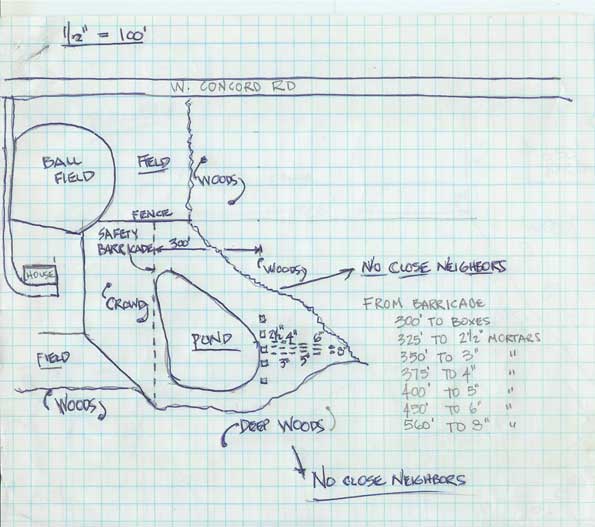
Sketch of a Fireworks Display Site
On the sketch, I define the areas where the crowd will be. I show where I'm going to erect a barrier of stakes and caution tape, beyond which the spectators will not be allowed.
I also measure off the minimum distances needed to maintain safe separation between the crowd and the various fireworks devices. NFPA 1123 is the code which establishes these distances. These measurements not only insure compliance with the law, they also help insure the safety of the crowd during the display. These distances are as follows:
75 feet for ground display devices like fountains, strobes, small wheels, etc.
125 feet for large wheels with powerful drivers, and other powerful ground devices.
125 feet for smaller multi-shot cakes, etc.
70 feet per inch of tube ID for Roman candles, aerial shell mortars, larger multi-shot cakes, etc. (i.e., 125 feet for 1.75" artillery shells, 210 feet for 3" shell mortars, etc.)
I then determine the maximum size of the devices that I can use in a display fired at this site. I keep these limits in mind as I select the product for my show.
These separation distances assume that mortars, cakes, etc., are securely supported and/or barricaded. This protects the crowd from debris fallout and from a falling "dud" shell or device. If a mortar is not securely supported, falls over, and fires directly at the spectators, these distances will not insure their safety. Therefore, care must be taken to securely place and support mortars and cakes in the field prior to firing.

Skylighter Festival Ball Mortar Rack
You'll notice that rockets are not mentioned in the above safe-distance specifications. Rockets are not typically used in professional displays any longer due to safety issues regarding the fallout of sticks and spent-motors. Rockets are used often in consumer fireworks displays, though.
Often the flight of a rocket is unpredictable even if it is fired from a secure, stable, and vertical launch support. I personally would not fire rockets in a show unless I could insure that the spent rockets absolutely would not be coming down on the upturned faces of spectators as they watch the show, or on parked vehicles. Injury and insurance claims are not on my list of "fun things" at a fireworks show.
You can see from all of the above that I take all of this seriously. Many of us see multiple examples every year of folks who have had a bit too much to drink, take some cakes and mortar tubes out to the back yard or into the cul-de-sac, have adults with kids standing in front of them about 30 feet away, and start firing away, whooping and hollering.
Most folks get away with this. Some do not. They either hurt themselves, or worse, some innocent bystander. And, as a result, fireworks get more of a bad reputation. Nothing would take the fun out of all of this more quickly for me than hurting some kid with my "hobby." I suppose I can't emphasize the safety aspects of this enough.
Show Budget
How much can I spend on fireworks for my planned display?Really! We've all gone into a fireworks shop, planning on picking up a couple of bags of fireworks for 50 bucks, and have walked out pushing two shopping carts full of brightly colored boxes after writing a check for $250.
Do you want your wife to be talking to you on the day of the show, and sitting there enjoying your artistry, with the house payment paid in full? Yeah, sometimes all of this feels a bit like an addiction, but I have to balance it in with all the other responsibilities in my life, and I hate fighting with my wife.
It might be $200 or $2000, but the budget helps a lot when it comes to actually picking out the fireworks to be shot on the night of July 4th.
Will I be paying for the fireworks all by myself, or will some friends be pitching in? It is probably a good idea to get a commitment, and even the cash up front before the shopping trip.
Just a few things to think about.
Fireworks to Its Own Music, or a Pyromusical
It can be a lot of fun to record a soundtrack to be played during the fireworks show. On the other hand, sometimes it's nice to just shoot the fireworks all by themselves, enjoying their rhythm and beat, and playing the whistles, reports, soft fountain hissing, color breaks, and rocket whooshes one after another.I like to shoot a show to music if possible. In the kind of show we are discussing, I'll simply choose some music based on the following criteria, and pick product that goes along with it. I don't try to get pin-point precision choreography. I'll save that for large, computer-fired shows.
Individual song download services like Napster and ITunes can be invaluable for finding and procuring great soundtrack songs.
One thing that I really think keeps an audience interested and entertained is variety. Folks are used to watching movies and television where there are ups and downs of emotion and action. Drama involves tension and relaxation, hard and soft, loud and quiet, slow build-up and climax. A good fireworks display will include the same.
We have found that, in general, 1-2 minutes of a particular song will keep an audience's attention. After that length of time, their minds will start to wander.
I think it's also important to keep the music recognizable. There are going to be loud fireworks going off which will obscure any music playing. I like to use a lot of hard-beats so folks can at least hear the beat of the song, and I also like to incorporate music in the soundtrack that folks will easily recognize and be able to follow along with.
Here are some possible musical themes to which appropriate fireworks can be choreographed:
- Patriotic songs: National Anthem, Taps, America the Beautiful, I'm Proud to be an American, etc. (Red/White/Blue fireworks, fountains, waterfalls, etc.)
- Kids' songs: Lion King's "Circle of Life," "Ghostbusters," "Linus and Lucy," theme from Charlie Brown, etc.
- Slow beginning beat: The beginning of The Who's "Won't Get Fooled Again" (strobes)
- Light, humorous songs: YMCA, disco songs, etc. (aerial shells, cakes)
- Soft operatic songs: "O Mio Babbino Caro," Andrea Bocelli's "Por Ti Volare," Israel Kamakawiwo'ole's "Over the Rainbow" (falling leaves cakes/shells, soft shells one at a time)
- Dramatic songs: "Theme from the Last of the Mohicans," Pirates of the Caribbean music, etc. (cakes and shells)
- Hard-beat finale songs: Hard Rock, Led Zepplin, Iron Butterfly, Queen, Black Sabbath's "Iron Man," etc. (hard-break and report finale cakes and shells, firecracker wall/tree)
I use Sound Forge audio editing software to cut, splice, and edit my soundtracks. I'm sure there are other programs out there, many of which can be obtained for free, with which we can assemble a fun soundtrack for our show. A final firing-script with firing times is used to fire the show.
Fired Electrically, by Hand, or a Combination of the Two?
Large, precisely-timed displays are typically fired electrically, and often the firing is controlled by a computer program. This is a bit out of the range of most small display operators. But manual electrical firing can easily be incorporated into some or all of the show to improve the pace and the timing of the show, and to insure that particular devices are fired at exactly the desired moment.The size of the firing system(s) will determine the number of cues (individual ignitions) you can incorporate into the display. If you only have a 12-cue system, there will be a maximum of 12 individual firings that you can have in the show, and the same goes for a 144-cue system.
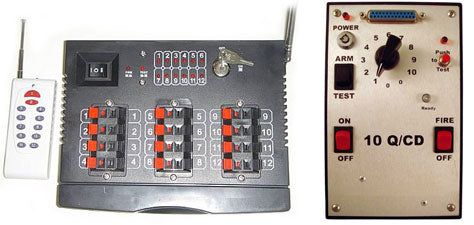
Electrical Fireworks Firing Systems
But with creative fusing techniques it is possible, to greatly expand the number of devices and the duration of the display segment that is fired with each cue, though. We will be expanding on that idea in a soon-to-come Fireworks Tips article.

Skylighter Firework Fuses: Green American Visco (#GN1000), Yellow Chinese Fast Visco (#GN1100), Superfast Paper Fuse (#GN1205), Quickmatch (#GN3001)
Some local fireworks clubs have yearly competitions in which a whole show is laid out on a sheet of plywood and the devices are fused together using various techniques for timing of the effects. The whole shebang is ignited using one fuse or firing cue.
Next week's article will focus on tips for wiring a display with various firing systems and include some tips for fusing devices together to expand the versatility of the electric firing cues.
If some or all of the display will be fired by hand, it's a good idea to have a scripted firing order and to have a firm idea of who will be helping to fire it. Rehearsing the firing of the display with all of the shooters will insure a smooth display after dark.
Hand firing safety is greatly enhanced by the use of a flashlight and propane torch, or a road flare taped to a stick. Head or helmet mounted flashlights are great during firing and post-display cleanup.
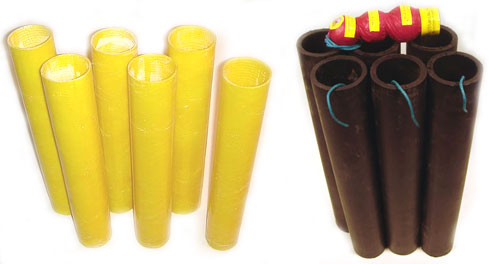
Skylighter HDPE and Fiberglass Festival Ball Mortars
If there is to be any reloading of artillery (festival ball, reloadable) shell mortars during the show, this needs to be thoroughly planned. Safe ready-boxes, which will contain the product to be loaded during the show, and their locations need to be planned. Segments during the show, when product is being fired in areas other than the area where the reloading is going on, are the only safe way to perform this operation.
Duration of the Display?
How long do we plan on having the fireworks show last? While it may be fun for us to take devices one at a time out to the shooting area and light them for hours on end, this may not be as entertaining for the crowd as it is for us.Folks are used to being entertained for a half hour at a time with well scripted TV shows. A fireworks show that lasts 15, 20, or 30 minutes and has a lot of variety in it can easily keep folks entertained. Beyond that amount of time, you will probably start to lose folks' attention.
Of course, the length of the show will depend on your budget. It's a good idea to keep at least 25% of the product for the show's finale, which might last a minute or two. So scripting the rest of the affordable devices in an entertaining way, overlapping their durations just a bit to avoid unplanned "dark sky," will determine the show's duration.
One way to increase the duration of the show, yet not put much of a dent in the budget, is to choose long-duration devices like fountains, strobes, wheels, and waterfalls, which can fill minutes of the display for a minimal expense.
What Devices Will Be Fired During the Show?
This all leads us to a discussion of the actual product we will be firing during the display. All of this will be determined by the show's budget, site constraints, choreography, and personal tastes.
Sky Lanterns Can Be Used in Daytime or Night
One fun addition to a show can be some pre-dusk firing of daytime effects. There is an increasing variety of daylight devices: smoke, Sky Lanterns, and streamer and parachute cakes. Kids love to run, chase, and try to catch the parachutes and streamers. Just make sure that the cakes produce fallout which is not still hot or otherwise dangerous for this kind of activity.
One really great way to pick out the product for a show is to attend the product demo at your local fireworks store. My friend Brian Lynch owns a store nearby in West Harrison, Indiana, Half Price Fireworks. Brian actually goes to China and hand-picks his favorite new devices for his shop. Often, these local, independent shops can give you the most bang for your bucks.
I attended one of Brian's product demos recently, and was handed a checklist/note-taking-sheet to use during the demonstration. Before the devices started to be fired, I organized my note-taking to include notes about these various aspects of the product:
- Height of device's display--low-medium-high (one cway to increase the variety in a show is to use various parts of the background (the sky): ground level, low sky, and high sky
- Loudness of the device (more variety can be planned if soft-medium-loud sections of the show are scheduled)
- Quality of the device, rated on a scale of 1-5
- Duration of the display of a device (I brought a stopwatch to use to record this time)
- Notes of the crowd's reaction to a device (laughter, WOW applause, quiet awe)
- Cost of the device, and its value for the money, (i.e. 12 seconds of a nice cake for $16, a line of soft-strobing fountains which last over a minute for $4)
One additional nice feature that many shops provide, including Brian's, is a label near each item which indicates the product's duration, effect, and often an actual photo of the device in action. This info can add to that which was gained at the product demonstration.
The layout of the planned devices can then be added to the sketch of the display site. Device variety, loudness variety, display height variety, and changes in durations and pace, all serve to keep the crowd interested in the show.
The safe use of some homemade devices, such as Cremora Fireballs, can really enhance a display while only lightly impacting the budget.
Safety Precautions
If there is to be hand-firing during the show, safety gear such as safety-glasses, hardhats, gloves, long-sleeved cotton shirts/jackets, and hearing protection will be in order.A five-gallon bucket of water for cooling off any possible burned hands, etc, is a good idea. Pump-up garden sprayers or a pressurized garden-hose/nozzle serve as fire extinguishers.
Have a first-aid kit on site.
Small radios or walkie-talkies can enhance communications between shooters during the show.
A barrier of caution-tape, stretched between fence posts, serves to keep the spectators in their designated areas before, during and after the display.
Thorough cleanup after the show, and a careful inspection of the site at daybreak following the display, serve to keep unfired devices out of the hands of children, who love to find and light or disassemble such items, often with disastrous consequences.
Planning for Inclement Weather
What are we going to do if it rains? A few years back I helped on a show worth tens-of-thousands of dollars. It was a hot, sunny July day, and the weather forecast predicted the same weather right through the evening. A half-hour before show time, a black, rolling wall of clouds formed on the northern horizon, and within 15 minutes the wind was howling and a hellacious thunderstorm rolled in.In the wind, there was no way to use tarps or plastic to cover our mortars and cakes, and the long waterfall and the set pieces were completely vulnerable. We lost the whole show, and had stacks of wet aerial shells and box-cakes that had to be somehow salvaged or disposed of safely. A real mess!
These types of experiences motivate most of us experienced display producers to take precautions against the ravages of inclement weather, no matter what the forecast is. I like to say, "If you don't want it to rain, cover everything up. If you want it to rain, act as if it's not going to."
Rolls of plastic or aluminum foil, and plastic tarps, work well to cover racks of mortars. Large plastic bags cover up individual cakes, and rolls of plastic stretch-wrap can be used for mortar racks, lines of fountains, etc. It can be hard to cover and protect a firecracker wall or a waterfall or set piece, so sometimes it's best to leave them lying on the ground and covered with plastic until the last minute if there is a questionable forecast.
Conclusion
With planning centered around all of these subjects, a successful, relatively stress-free, safe, and fun fireworks display can be produced. Most folks will never know the amount of work that goes into a good show, but they also will never get to experience the satisfaction that comes from creating such a work of art and hearing the audience's cheers during and after it.In the next few weeks, in Fireworks Tips articles, we'll be focusing more on the electric wiring and fusing of a display, the assembly of mortar racks and supports for wheels, firecracker walls/trees and waterfalls, and the actual layout/placement/assembly/support of a consumer fireworks show.
Stay tuned and stay green,
Ned
Materials Needed
- Visco Fuse
- Chinese Fast Visco (GN1100)
- Consumer Fireworks
- Display Site Sketch
- Mortar Tubes (PL3182)
- Plastic Bags
- Plastic Wrap or Aluminum Foil
- Quickmatch (GN3001)
- Superfast Paper Fuse (GN1205)
- Tarps
- Electrical Firing System
- Ematch Tester
- Ematches (GN5040 & GN5050 if not premade)
- Shooting Wire
- If Firing Electrically:
- If Hand-Firing:
- Cotton Clothing
- Gloves
- Hard hats
- Safety Glasses