
Consumer Fireworks Display:
The Day of the Show
Entertainment Prior to the Show
In the half-hour leading up to show time, I have some devices to shoot to entertain the kids, and to use to get the crowd ready for the main event.I purchased some smoke cakes, which will look nice against the twilight sky, and a couple of parachute cakes which will give the children something to chase and collect. I've made sure that these parachutes do not come back to earth with anything hot attached to them, which could injure the kids.
I'm also going to launch some Sky Lanterns at dusk. These take a few minutes to launch and fly away, and the crowd always gets quiet and enjoys watching them float out of sight.
Launching Sky Lanterns Electrically
This proved to be more challenging than it sounds. Several of us have been working on methods to accomplish the electrical ignition and launching of Sky Lanterns.The method I'm currently using involves priming 3 inches of a 4-inch piece of Visco Fuse with the following prime:
- 1 ounce of black powder "green mix," which consists of 0.75 ounce of potassium nitrate, 0.15 ounce of airfloat charcoal, and 0.10 ounce of sulfur, all mixed by screening through a 40 mesh screen several times.
- 0.2 ounce of titanium or magnalium, somewhere around 100 mesh
- 1.3 ounces of PVC glue (Thanks to John Miller for the idea of using PVC glue in items like this.)
To electrically fire the Visco, I tape a one inch piece of Fast Fuse (Skylighter #GN1205) into the end of an ematch, and then tape the Fast Fuse to the Visco.

Visco, Primed and Ready to be Electrically Fired
Now I take a small, round cosmetics pad (stolen from my wife, Molly) and smear a very thin layer of petroleum jelly on both sides of it. This pad is placed on the top of the Sky Lantern burner (the fuel pad)--that is, the side of the burner facing the inside of the lantern.
I tie a piece of string around the midpoint of the Visco fuse priming, and tie the fuse to the top of the jellied-pad, with the string going around the lantern burner. This string-tie keeps the fuse from coming loose from its position if the lantern moves in a breeze, or when the igniter fires.
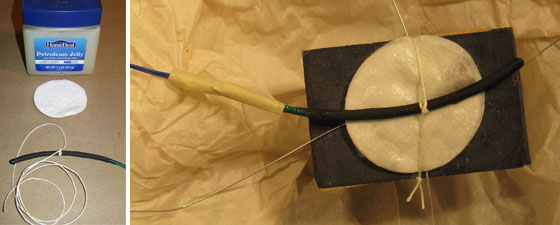
Fusing the Sky Lantern Fuel Pad
To erect the Sky Lantern in the field, ready to be fired, I stick a rounded-top pole into the ground. This stick is just long enough to hold the Sky Lantern fully stretched out with the bottom hoop just resting on the ground. The rounded top of the pole helps prevent it from tearing through the fragile tissue paper.
The lantern is now ready to be ignited and sent aloft electrically.
I have also recently used only the primed Visco fuse stuck between the layers of the burner assembly. This has worked consistently for lighting the burner, but it takes a bit longer for it to really get burning. There is room for more R&D in this process.
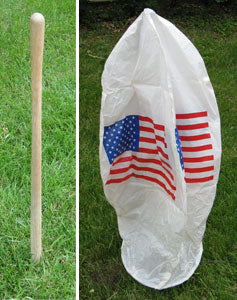
Sky Lantern Launching Pole and Ready to be Launched Electrically
The Script and Layout of the Main Show
Now that the pre-show festivities have been covered, it's time to move on to the main show. I've intentionally kept this show simple, small in size, economical, and employing only relatively small and quiet devices.I have also edited a simple soundtrack to be played on a boom box in front of the small crowd of family and friends during the show.
I've actually laid out on the ground the various fireworks devices that will be in the show. I've organized them in a line in the order I want to fire them, starting with some slow, smaller items, working through some smaller cakes, firing a waterfall and set piece, shooting some comets and rockets, displaying a consumer wheel and the hand-made cone-fountain Chromatrope, then some 500 gram cakes, and ending with some chained artillery shells, a firecracker tree, firecracker wall, and some large Cremora pots.
There is a lot of variety in this lineup. Small and large items, low and high items, slow and fast-paced items, lots of different kinds of devices, building up to the bigger stuff, and then a loud and impressive finale.
Laying this lineup out on paper, I've overlapped quite a few of the items' display durations by 5 seconds to avoid dark sky except in the few instances where I want that dark sky to display rockets against.
The show script then looks like this:
| Timing | Firework | Music |
| 5,4,3,2,1, | Fire | |
| (Start stopwatches at "Fire") | ||
| 00:02 | Strobing fountains | Who's "Won't Get Fooled Again" |
| 00:30 | Mine | |
| 00:33 | Mine | |
| 00:37 | Mine | |
| 00:43 | Comet | |
| 01:00 | Line of cone fountains | |
| 01:16 | Comet | |
| 01:20 | Purple Ball cake | "Are You Ready for This?" |
| 01:45 | Excellent Trip cakes | Disco/Upbeat music |
| 02:10 | Squealing Pig cakes | |
| 02:40 | Photo Flash cake | |
| 03:05 | Going in Circles cakes | |
| 03:50 | 3 fanned comets fire | |
| 03:55 | Waterfall | "O Mio Babbino Caro" |
| 04:15 | Star Set Piece | |
| 04:28 | 3 Comets fire | |
| 04:32 | Rocket Volley fires | |
| 04:45 | PyroWheel lights | Lion King's "Circle of Life" |
| 05:03 | Chromatrope lights | |
| 05:35 | My Favorite Martian cake | |
| 05:55 | Horsetail Barrage | "Somewhere Over the Rainbow" |
| 06:15 | Gold Lightning | |
| 06:50 | Timed-chain shell rack | |
| 07:05 | Quick-chained shell rack | Golden Earring "Radar Love" |
| 07:10 | Firecracker Tree | |
| 08:55 | Firecracker Wall | |
| 10:00 | Five-Gallon Cremora pot | |
| 10:05 | Five-Gallon Cremora pot | |
| 10:10 | 2 Five-Gallon Cremora pots |
As I lay the devices out, and wire them to the firing system, I'll make a note of the firing cue number to the left of the firing time so that I know which cue to fire at that time.
Note: Since I'm igniting the existing Visco fuse on the various devices after clipping off a bit of it, I'm "pre-firing," by two seconds, comets, mines, and other devices that I want to shoot at a particular time. This gives the Visco a couple of seconds to burn before the device is supposed to display.
Soundtrack
With this firing script nailed down, I can assemble and edit the soundtrack using my Sound Forge editing software. I always start a manually-fired soundtrack with a countdown, 5,4,3,2,1, ending with "Fire", which is where I start the timers by which I fire the show.Sketch of the Layout
I've drawn up a rough sketch of the layout of the show, as shown in the Planning a Consumer Fireworks Display article. This shows my safe distances to the crowd, and the layout of the firing system and scab wire, too.What I Will Need for the Show
Now, in order to keep it simple in my head, I envision the show, one step and device at a time, starting with the pre-show items, and create a checklist of all the items I'll need to set everything up and fire it all. This is especially important if I'll be shooting the show at a remote location.Checklist
- table, chairs, pop-up-tent shelter
- food and drink
- CD player/batteries, 2 copies of soundtrack CD
- 3 copies of paper firing script
- 3 copies of layout sketch
- caution tape and posts to use to erect a safety barrier
- firing system (fully charged or with new batteries)
- electric matches
- scab wire
- stopwatches
- battery tester/multimeter
- propane torch
- fire extinguisher, garden sprayer (filled)
- flashlight, headlamps
- first aid kit
- sunscreen
- bug spray
- sunglasses
- sledge-hammers
- screw gun
- screws
- roll of iron wire
- tool box, hand tools
- spikes for strain relieving wires
- kraft paper to use to make "chain buckets"
- Elmer's glue
- Sky Lanterns, launching poles, ignition supplies
- concrete blocks, bricks
- wooden stakes
- rebar stakes
- ready boxes for reloading shells
- duct tape, masking tape, aluminum foil tape
- plastic garbage bags, aluminum foil, tarps, rain protection
- quickmatch
- string
- All of the fireworks product (Duh!!)
- rocket launching tubes
- camera
- step-ladder
- fence-posts, fence-post driver, fence-post puller
- mortar racks, loose individual mortars
- wood blocks
- lumber to erect waterfall, cracker tree and wall, wheels, set piece
- Cremora buckets, Cremora, black powder, napkins
- measuring scoops, weighing scale
Preparation of Fireworks Devices
Before the day of the show, I prep the various devices that will be in the display. I install paper or aluminum-foil-tape buckets on all devices that will be chained together. I load and chain-fuse the shells that will be shot from mortar racks. I also have pre-assembled the Chromatrope.I equip the cakes and other devices with ematches and quickmatch or Fast Fuse passfires.
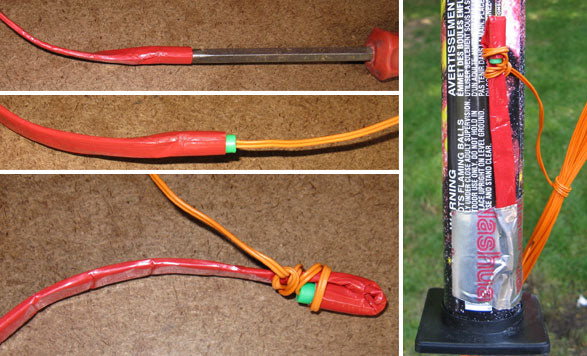
Installing Electric Match in Quickmatch, and Ematch Pigtail onto Device's Visco Fuse
I assemble the set piece. My buddy Jeremiah Smith, winner of the Best Consumer Fireworks Show competition at the National Fireworks Association convention in 2007, developed and shared this method of using large Ground Bloom Flowers to create a Consumer Fireworks set-piece.
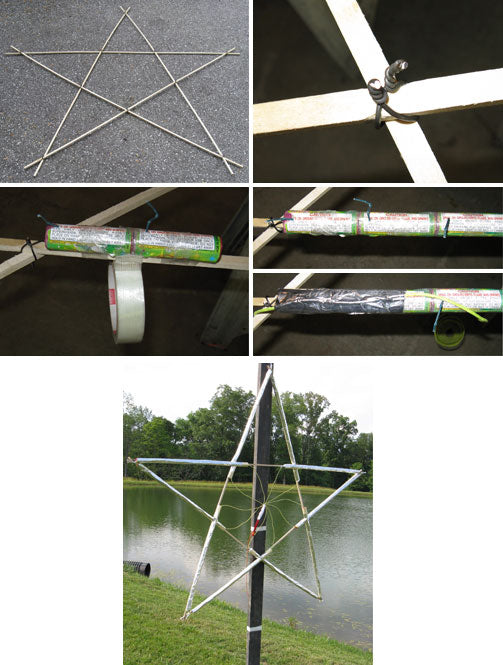
Star Set-Piece Using Ground Bloom Flowers and Fast-Visco Fusing
I sketch each support apparatus that will be used for the waterfall, wheels, and firecracker wall and tree, and I make a list of lumber that I'll need for it all.
The firecracker tree has been pre-assembled using two, 8000-firecracker rolls.
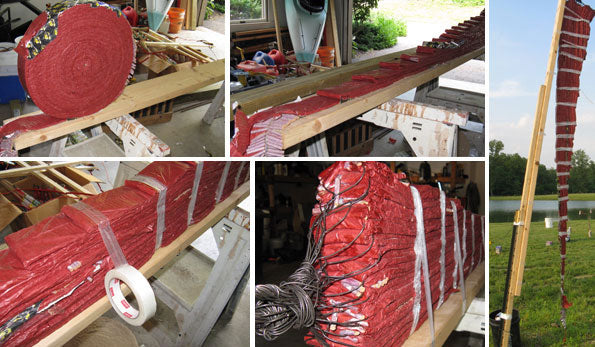
Assembling and Erecting the Firecracker Tree
The Day of the Show
So, now it's time to load the truck and head out to the shoot site. Fortunately my Lovely Assistant was able to take the day off to help me out there.Rebar pins, wood stakes, or large barn spikes come in handy for erecting strobes, fountains, cakes, etc. I use quickmatch to connect all the strobes or fountains in a line.
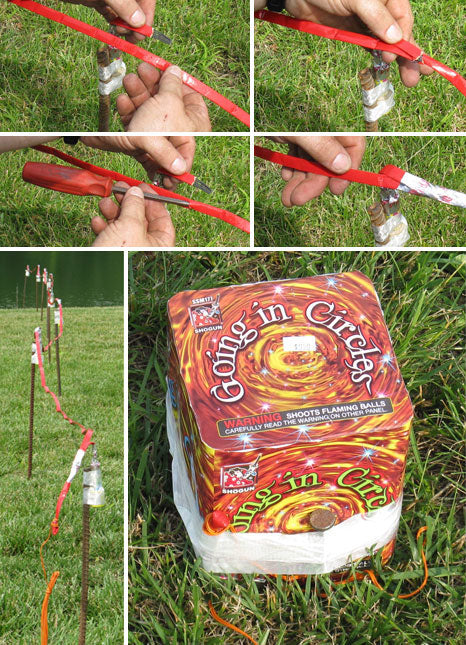
Quickmatching a Strobe Line, and Anchoring Cakes with Barn Spikes
I assemble and erect the cone-fountain waterfall.
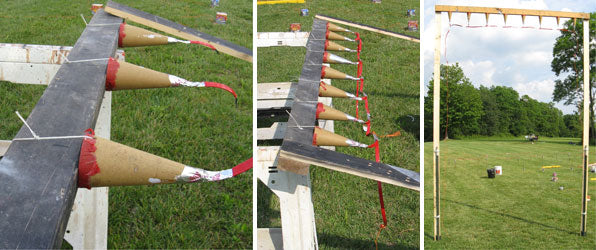
Cone-Fountain Waterfall
Then the rocket rack and firecracker wall go up.

Chain Fused Rockets in Rack, and Firecracker Wall
Everything else is set up and wired to the firing system, with each firing circuit checked with the multimeter. See Wiring Devices and Firing Systems in a Consumer Fireworks Display for details.
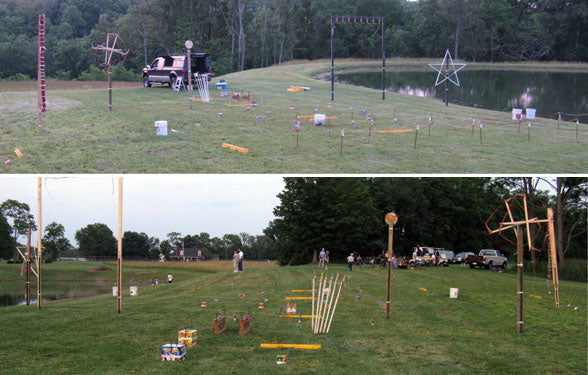
The Complete Show Set-Up
If I was shooting this show on a paved parking lot, I'd assemble self-supporting frames for each device, and I'd support the fountains and cakes with concrete blocks and bricks. Naturally I don't use this method for anything powerful which might blow up and send pieces of brick flying toward the crowd.
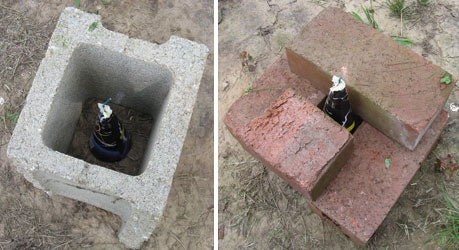
Supporting Devices with Concrete Blocks or Bricks
Naturally, many of these details will vary from show to show, from site to site, and from device to device, but hopefully all of this information will serve to whet your creativity and imagination.
Post-Show Notes
I brought some leaf rakes to the site the next day to clean up as much of the paper debris as possible. I thoroughly checked the site in the daylight for any dud devices or live product.Thinking back on the show, the best crowd reaction came when the Chromatrope functioned, when the star set-piece lit and when the cracker-wall did its thing, and, of course, when the 4 Cremora pots shot their hot fireballs into the air.
For a simple, 10 minute "backyard display," the audience really enjoyed it and offered grateful responses. It's always fun to see families, folks, and children get together, romp around tossing Frisbees and baseballs until dark, and then sit around a fire and enjoy a little fireworks show.
It makes the hours and hours of work that go into the show worth it.
Have Fun, Stay Green, and Have a Happy Fourth of July,
Until next time, Enjoy!
Ned
Materials Needed
- 100 Mesh Titanium or Magnalium
- Visco Fuse
- Battery Test/Multimeter
- CD Player and Soundtrack, if using music
- Caution Tape and Posts
- Concrete Blocks, Bricks
- Consumer Fireworks
- Cotton String
- Cremora Supplies: Buckets, Cremora, Black Powder, Knapkins
- Display Site Sketch
- Duct Tape, Masking Tape, Aluminum Foil Tape
- Electric Matches
- Fire Extinguisher
- Fireworks Disoplay Script
- Firing System
- First Aid Kit
- Flashlights
- Green Black Powder
- Iron Wire
- Lumber
- Measuring Scoops
- Mortar Racks
- Petroleum Jelly
- Propane Torch
- PVC Cement
- Quickmatch (GN3001)
- Rain Protection: Plastic Bags, Aluminum Foil, Tarps
- Ready Boxes
- Rocket Launching Tubes
- Round Cosmetic Pad
- Rounded-top Pole
- Scab Wire
- Scale
- Screw Gun and Screws
- Sky Lanterns
- Sledge-Hammers
- Stakes
- Stopwatches
- String
- Super Fast Paper Fuse (GN1205)