
Using Homemade Gerbs Creatively
Introduction
I've made some homemade gerbs, also called fountains, using either a gold glitter composition or a silver titanium one. These fountains create nice effects, either fired one at a time, or in a "front" with the gerbs in a line, spaced 8-10 feet apart.
Homemade Silver Titanium Gerb
One of the things I really love about handmade gerbs is their versatility. In this article I will show you how to incorporate these fountains in some other creative devices:
- I'll mount some gerbs on a frame to create a waterfall.
- I'm going to show how to make a very simple, beautiful, color-changing wheel.
- I'll recreate the Chromatrope wheel.
- I'll show how to make a simple set-piece in the shape of a star, using two different types of titanium in the silver formula.
- And a simple line rocket will be assembled.
Making the Gerbs
I totaled up the number of the glitter gerbs and the titanium fountains I need for all the projects I have planned, and I rammed them as described in, "Making Gerbs (Fountains)".I drilled 1/4-inch nozzle holes in all of them except the four titanium gerbs that I have planned for the sample waterfall. I made 3/8-inch apertures in those nozzles so that they spray the silver sparks out more gently.
Also, the glitter gerbs are going to be used in pairs with the titanium ones. The glitter gerbs will burn, and then they will passfire from their bulkhead ends to the nozzle end of the Ti ones. So, I've drilled 1/4-inch passfire holes through the bulkheads of the glitter fountains.
When they are going to be used individually, I fuse the gerbs with Visco as shown in the photo above. But when they will be used in devices such as the ones I have planned for this project, I fuse them differently.
I cut some 4-inch lengths of thin blackmatch from Quickmatch or Super Fast Paper Fuse. This match is doubled and inserted into the nozzle holes of the gerbs.

Lengths of Thin Blackmatch, Cut, Doubled, and Inserted into Gerb Nozzles
I screen together, through a 40 mesh screen, a black powder prime composition, consisting of:
| Component | Ounces |
| Potassium nitrate | 1.5 |
| Air float charcoal | 0.3 |
| Sulfur | 0.2 |
| Dextrin | 0.1 |
In a paper cup, I add enough water to the prime powder to create a slurry with the consistency of jam. This slurry is put in a plastic baggie, the top of the baggie is twist-tied closed, and the excess plastic is cut off. I clip a very small corner off of the baggie, and pump the prime into the nozzle holes until they are full.
I finish this priming/fusing off with a dusting of fine black powder granules, and the prime is allowed to dry for a couple of days.

Priming the Gerbs with Black Powder Slurry
This combination of blackmatch and black powder prime ensures a very positive ignition when the flame from quickmatch fusing reaches the ends of the gerbs.
Now I install paper buckets on the fused ends of all the gerbs, and on the passfire ends of the glitter gerbs. These buckets consist of 4-inch by 9-inch pieces of 40-pound kraft paper glued and rolled onto the ends of the paper tubes, resulting in a double walled bucket.

Installing Paper Buckets on Gerbs
Making a Waterfall
Traditional waterfalls use thin-walled paper tubes filled with a potassium perchlorate and aluminum composition, and hung pointing downward. The waterfall I'll be making with these silver titanium gerbs will be a little different than that.I was watching a special on Niagara Falls the other day, and I noticed that the water projects horizontally off of the rock river-bed and then gradually arcs over and starts to fall vertically. I started to wonder if something like that could be done with these Ti gerbs.
So, as an experiment, I'm going to mount four Ti gerbs, with the 3/8-inch nozzle apertures, horizontally on a board, 12 inches apart. I'm interested in seeing what sort of effect that produces.
Note: In past articles I've shown how Super-Fast Paper Fuse or Fast Yellow Visco can be wrapped with aluminum foil duct tape to produce quickmatch if one does not have access to that fuse.
Four-Tube Waterfall
I was not completely thrilled with the effect this falls produced. Many of the silver sparks burned out flying horizontally before they started to fall vertically. Even with the 3/8-inch nozzle aperture the gerbs still had too much thrust.
The next day I decided to make one gerb without any nozzle at all. I just pressed silver-titanium comp into the tube, and burned it. I was happier with the unchoked tube and would use gerbs in that configuration in the future. The waterfall effect would have been better with 16-foot vertical supports instead of the 12-footers that I used this time.
Single-Tube Waterfall (No Nozzle)
Making a Simple Color-Changing Wheel
For the wheel frame, I took a 4-foot piece of 1x2, and mounted a threaded tube through a hole in the center of it. I will later use a 1/4-inch lag bolt to mount the wheel to a vertical support post.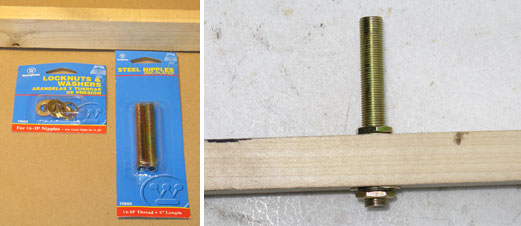
Then I drilled a pattern of holes in the ends of the 1x2, through which I'll tie on the gerb drivers.

I use waxed string to tie the glitter gerbs to the outer end of the 1x2, nozzle end pointing out. Then the Ti gerb is tied on next to it facing in the same direction. These drivers end up staggered so that the glitter gerb's sparks do not ignite the fusing of the Ti gerb.

A quickmatch passfire is tied into the passfire end of the glitter driver and over into the thrust end of the Ti one.
I tie the pair of gerbs together to further improve their stability. Additionally, I covered the string ties with aluminum foil duct-tape so that there would be no chance of the ties burning through when the passfire ignites.
Note: In the past, to attach drivers, I've used plastic zip-ties, or iron wire, which are both less susceptible to flame damage, but this time I wanted to use the string, which is simpler, less expensive, and lighter.

The completed wheel is now ready to mount to a support post. There is a wood block at the top of the post to space the wheel out and away from the support to keep the wheel from hitting it.
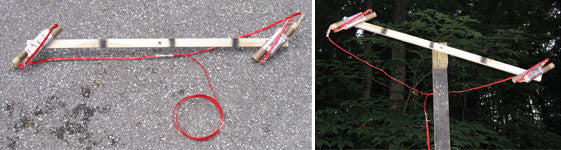
Completed Wheel with 2 Pairs of Glitter and Titanium Gerb Drivers
When I am attaching the quickmatch drop-leader to a device which is designed to move, such as a rocket, girandola, or wheel, I always install a "positive disconnect" section. A "positive disconnect" is simply a section in the quickmatch which is designed to burn through and fall away. This is done by exposing, and overlapping bare blackmatch from the ends of two pieces of quickmatch and wrapping with clear packing tape. I then tie the packing tape bucket to secure it in place.
This disconnect ensures that the plastic-and-paper match pipe and the blackmatch string actually detach from the device. I have had moving devices fail to move due to the incomplete detachment of the quickmatch leader. This is a bad thing.

Positive Disconnect Section Constructed in Quickmatch Leader
Note: Mounting the drivers at a 45-degree angle to the 1x2, instead of at a 90-degree angle increases the final wheel display's diameter. It also decreases the thrust that the drivers impart to the wheel, thereby slowing its rotation and making it appear more graceful.

Drawing of Drivers Mounted at 45-Degree and 90-Degree Angles
Note: As I was constructing the wheel, I was constantly thinking through the ignition and burn sequences, and imagining all the possible things that could go wrong and could be avoided. The aluminum foil over the string ties was such a counter-measure. In even this small wheel there is a lot of time and effort and I'd really like it to work well. There's a huge difference in the feeling I have when something works as designed, as opposed to disappointment I feel when it crashes and burns.
Simple, One-Armed Color-Changing Wheel
Making a Homemade Chromatrope
I also remade the Chromatrope wheel, this time with homemade gerb-drivers. The ends of the arms on the two wheels will have pairs of gerbs mounted on them in exactly the same manner as the simple wheel above. One wheel will rotate clockwise, and the other will move counterclockwise.
Assembly of Chromatrope Wheel
Chromatrope Wheel with Homemade Drivers
Making a Star Set-Piece
Homemade fountains can be arranged in a multitude of ways to create a set-piece, forming letters, a word, or any other design.I decided to create a simple, 5-fountain, star set-piece to illustrate what can be done with these gerbs.

Star Set-Piece and Driver Shim
I used 12-foot 1x4's to make the framework, and mounted the gerbs with zip-ties and a shim under the nozzle end to slightly point the exhaust out away from the frame. The shim is simply a section of a 1.25-inch ID paper tube.
For this little project I made 5 gerbs with the coarse spherical titanium (CH3001) and 5 with the fine spherical Ti (CH3010). The two effects were dramatically different.
Star Set-Piece Using Coarse Spherical Titanium
Star Set-Pieces Using Fine Spherical Titanium
The first star, using the coarse Ti, could have easily been made twice as large, and the second star with the fine Ti could have been made slightly smaller.
Line Rocket
With one last little bit of creativity, I assembled a couple of line rockets. The first one had one driver (this type of rocket makes a nice effect flying into a bonfire as the fire is lit). The second one had two drivers in opposite directions, one burned then passed fire to the other, produced a back-and-forth flight.In both cases, the gerbs were taped to a piece of PVC plumbing pipe which has the same OD as the fountain tubes.
The pipe is installed on a length of iron wire as the wire is strung tightly between two solid supports, like trees.
In this case, in order to develop enough thrust with the Ti gerbs, I drilled the nozzles with a 3/16-inch drill.
Line Rockets
In his book, Introductory Practical Pyrotechnics, Tom Perigrin has some fun ideas for other creative variations on the line-rocket theme. Rat Packs, Jeweled Rats, Pigeons: So many experiments, so little time.
Conclusion
So there you have it. Plenty of ideas on ways to put simple homemade gerbs to use. They don't make much noise, they are relatively safe, their effects last a long time, they make for instant gratification, and they offer endless opportunities for creativity.
Have fun and stay safe,
Ned